
|
Getting your Trinity Audio player ready...
|
SURVEY. From Congressman Sam Liccardo‘s Office on April 2nd, 2026.
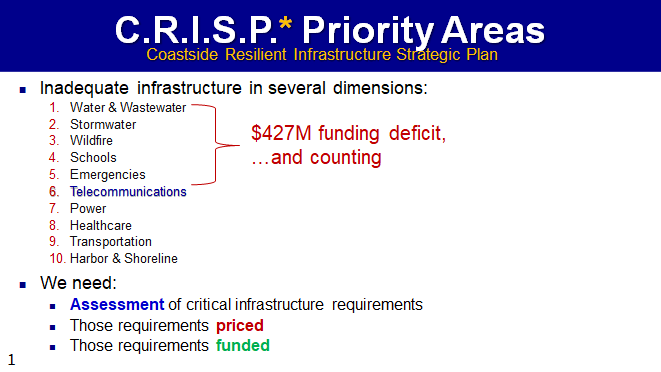
CRISP = San Mateo County CRISP (Coastal Resilient Infrastructure Strategic Plan)
We have identified strengthening Coastside infrastructure as one of our top priorities for the district, and we’re working with our local leaders to move critical projects forward. We’d like your help in focusing our time and federal resources. Please rank the following from most (1) to least (11) important in priority
Survey
Kindly share the survey with your networks, including your neighbors, and other leaders on the Coastside that may not have been included at the first convening of the Partnership for Coastside’s Future on December 5th, 2025.
Congressman Liccarod’s Website | Instagram | Facebook | YouTube
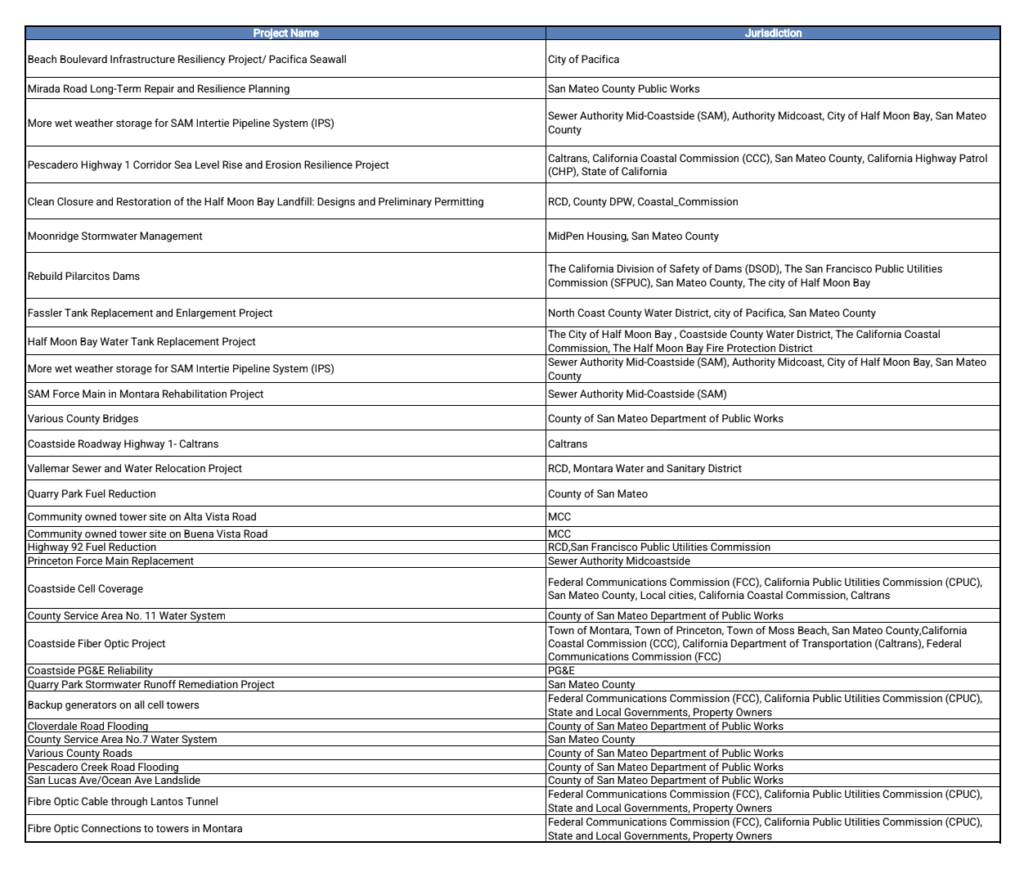
San Mateo County CRISP List
More on CRISP (Coastal Resilient Infrastructure Strategic Plan) on Coastside Buzz.
Coastal Resilience – Federal Grant Opportunities
FEMA Hazard Mitigation Grant Program
FEMA’s Hazard Mitigation Grant Program (HMGP) provides funding to state, local, tribal and territorial governments to develop hazard mitigation plans and rebuild in ways that reduce or mitigate future disaster losses in their communities. This funding becomes available following a Presidentially declared disaster and must be requested by the governor. To receive HMGP funding, all state, local, tribal and territorial governments must develop and adopt hazard mitigation plans.
The amount of HMGP funding available to the applicant is based on the estimated total federal assistance, subject to the sliding scale formula that FEMA provides for disaster recovery for each disaster declaration.
The formula provides for:
Up to 15% of the first $2 billion of estimated aggregate amounts of disaster assistance.
Up to 10% for amounts between $2 billion and $10 billion.
Up to 7.5% for amounts between $10 billion and $35.333 billion
FEMA Pre-Disaster Mitigation Grant Program
The Pre-Disaster Mitigation (PDM) grant program makes federal funds available to state, local, tribal, and territorial governments to plan for and implement sustainable cost-effective measures designed to reduce the risk to individuals and property from future natural hazards, while also reducing reliance on federal funding from future disasters.
A non-federal cost share is required for all subapplications funded through the Pre-Disaster Mitigation grant program. The non-federal cost share may consist of cash, donated or third-party in-kind services, materials, or any combination thereof. Generally, the cost share is 75% federal and 25% non-federal cost share.
This is a Community Project Funding program, meaning Congress must individually select and fund each project as part of the annual appropriations process.
Drinking Water State Revolving Fund
Under the Drinking Water State Revolving Fund, EPA provides grants to all 50 states plus Puerto Rico to capitalize state DWSRF loan programs. The states contribute an additional 20 percent to match the federal grants. States are responsible for the operation of their DWSRF programs.
Under the DWSRF, states may provide various types of assistance, including:
Loans
Refinancing
Purchasing
Guaranteeing local debt
Purchasing bond insurance
States rank the project applications they receive from water systems and produce a Project Priority List. States have flexibility to tailor their ranking process while meeting the SDWA requirement to give priority to projects that:
Address the most serious risks to human health
Are necessary to ensure compliance with the SDWA
Assist systems most in need according to state affordability criteria
Clean Water State Revolving Fund
The 51 Clean Water State Revolving Fund programs function like environmental infrastructure banks by providing low interest loans to eligible recipients for water infrastructure projects. As money is paid back into the state’s revolving loan fund, the state makes new loans to other recipients for high priority, water quality activities. Repayments of loan principal and interest earnings are recycled back into individual state CWSRF programs to finance new projects that allow the funds to “revolve” at the state level over time.
States are responsible for the operation of their CWSRF program. Under the CWSRF, states may provide various types of assistance, including loans, refinancing, purchasing, or guaranteeing local debt and purchasing bond insurance. States may also set specific loan terms, including interest rates from zero percent to market rate and repayment periods of up to 30 years. States have the flexibility to target financial resources to their specific community and environmental needs.
States may customize loan terms to meet the needs of small communities, or to provide incentives for certain types of projects. Beginning in 2009, Congress authorized the CWSRFs to provide further financial assistance through additional subsidization, such as grants, principal forgiveness, and negative interest rate loans. Through the Green Project Reserve, the CWSRFs target critical green infrastructure, water and energy efficiency improvements, and other environmentally innovative activities.
Promoting Resilient Operations for Transformative, Efficient, and Cost-saving Transportation Program (PROTECT)
The Promoting Resilient Operations for Transformative, Efficient, and Cost-saving Transportation (PROTECT) Grant program provides funding to ensure surface transportation resilience to natural hazards including climate change, sea level rise, flooding, extreme weather events, and other natural disasters through support of planning activities, resilience improvements, community resilience and evacuation routes, and at-risk coastal infrastructure.
There are four types of PROTECT grants:
- Planning
- Resilience Improvement
- Community Resilience and Evacuation Route
- At-Risk Coastal Infrastructure
A benefit-cost analysis (BCA) is required for this grant program. Eligible uses include highway, transit, and certain port projects that include resilience planning, strengthening and protecting evacuation routes, enabling communities to address vulnerabilities and increasing the resilience of surface transportation infrastructure from the impacts of sea level rise, flooding, wildfires, extreme weather events, and other natural disasters.

Author: mdrag
x