
Planning Commission Hearing and Regular Meeting – November 18, 2026.
The full agenda will be posted 72 hours before the meeting, sometimes earlier.
When it is posted, it will be added to the event post.
Read this:
Date of Distribution: October 23, 2026
The County of San Mateo is preparing a Draft Environmental Impact Report (EIR) for the Housing Element Rezoning Program Phase 2 – El Granada (Project), as identified below, and is requesting comments on the scope and content of the Draft EIR. The Draft EIR will address the potential physical and environmental effects of the Project for each of the environmental topics outlined in the California Environmental Quality Act (CEQA, Public Resources Code Section 21000 et seq.)
The County of San Mateo (County) is the lead agency for the Project and has determined that preparation of an EIR is required to comply with CEQA. Once a decision is made to prepare an EIR, the lead agency must prepare a Notice of Preparation (NOP) to inform all responsible and trustee agencies, interested parties, and organizations that an EIR will be prepared (CEQA Guidelines Section 15082). The purpose of the NOP is to provide agencies with sufficient information describing both the proposed project and the potential environmental effects of the project to enable the agencies to make a meaningful response regarding the scope and content of the information to be included in the EIR. The County is also soliciting comments on the scope of the EIR from the public.
This NOP is being sent to the California State Clearinghouse, San Mateo County Clerk, adjacent cities and counties, potential responsible agencies, other public agencies, and interested parties. Responsible agencies are those public agencies, in addition to the County of San Mateo, that may have a role in approving or carrying out the Project. When the Draft EIR is published, a Notice of Availability of a Draft EIR will be sent to responsible and trustee agencies, other public agencies, and interested parties and individuals who have requested such notice.
NOP COMMENT PERIOD
A 30-day public review period for the NOP begins on October 26, 2026, and ends on November 24, 2026.
All written comments regarding the EIR must be received by November 24, 2026, at 5:00pm.
Responses to this NOP and any questions or comments should be directed in writing to:
Will Gibson, Planner III, Planning & Building Department, 455 County Center, Redwood City, CA 94063; or email to wgibson@smcgov.org.
In addition, comments may be provided at the EIR Scoping Meeting (see below). Comments should focus on possible impacts on the physical environment, ways in which potential adverse effects might be minimized, and alternatives to the proposed Project.
EIR SCOPING MEETING
The County of San Mateo Planning Commission will conduct a public scoping session during its regularly scheduled meeting on November 18, 2026, starting at 9:00 a.m. This meeting will be held in person in the Board Chambers located at 500 County Center, Redwood City, California. Those interested in viewing or participating in the meeting may also do so from remote locations via the Zoom application. For meeting agenda and updates, including the Zoom link for the meeting, visit http://planning.smcgov.org/planning-commission.
PROJECT BACKGROUND
The 2023-2031 San Mateo County Housing Element was certified by the California Department of Housing and Community Development (HCD) in May 2026. The certified Housing Element contains Housing Element Program HE 11.2, which proposed rezoning of a number of parcels throughout the County to address the County’s housing need.
The primary goal of Housing Element Program HE 11.2 is to allow for greater residential density and a streamlined design review process for new multifamily residential development on select sites in unincorporated San Mateo County. The commitments in Program HE 11.2 are meant to facilitate construction of new housing and address a lack of capacity to accommodate unincorporated San Mateo County’s Regional Housing Needs Allocation (RHNA) for very low-, low- and moderate-income households.
Housing Element Program HE 11.2 identified 137 parcels to be rezoned in four distinct areas of unincorporated San Mateo County:
1) the Broadmoor area;
2) the Colma area;
3) the Belmont Harbor Industrial area; and
4) the census-designated coastal El Granada community.
The first phase of the Rezoning Program included the identified parcels in Broadmoor, Colma, and the Harbor Industrial Area; this phase has been completed. The second phase includes the parcels proposed to be rezoned in the El Granada area.
The County has determined that an EIR is required for compliance with CEQA for the six parcels located in the El Granada community. This current NOP invites comments on the scope and content of the Draft EIR to be prepared to address the potential physical and environmental effects of the land use and zoning amendments to implement Housing Element Program HE 11.2 for the El Granada sites.
PROJECT DESCRIPTION
The proposed Project is the implementation of the second phase of Program HE 11.2 consisting of amendments to the San Mateo County General Plan, Local Coastal Plan, Montara-Moss-Beach-El Granada Community Plan, and Zoning Regulations of San Mateo County Ordinance Code to expand opportunities to construct high-density housing on six parcels within the El Granada area of unincorporated San Mateo County.
In adopting Program HE 11.2, the County committed to creating a new set of development and design standards for the El Granada area; these standards must be implemented with the Project. New standards will consider existing conditions, including surrounding uses, densities, infrastructure, and neighborhood character. As enumerated in HE Program 11.2, the amended development standards for the Project area must include:
increasing allowable residential density from a maximum of eight and 17 units per acre to a maximum of 70 units per acre with a minimum of 30 units per acre;
eliminating residential floor area and minimum lot area per unit standards;
reducing minimum front, side, and rear yard setbacks to 10 feet or less; reducing parking ratios to maximum one space per residential unit;
increasing maximum building height to 60 – 70 feet or other heights sufficient to allow the increase in allowed residential density of a given parcel;
limiting floor area of mixed-use development to maximum 25 percent; and
creating objective, measurable design standards governing building form within the Project area to support streamlined, staff-level review of new multifamily residential development proposals.
The intent of the Project’s policy and regulatory amendments is to streamline the entitlement process for future housing development proposals; no specific development is proposed or approved in conjunction with the Project. The Housing Element Rezoning Program Phase 2 – El Granada EIR would facilitate future residential development consistent with the amended regulations, in accordance with CEQA Guidelines Section 15168 (Program EIR), Section 15182 (Projects Pursuant to a Specific Plan), and Section 15183 (Projects Consistent with a Community Plan or Zoning).
Additional information about the Project is available online at https://www.smcgov.org/planning/san-mateo-county-housing-element-rezoningprogram.
PROJECT LOCATION
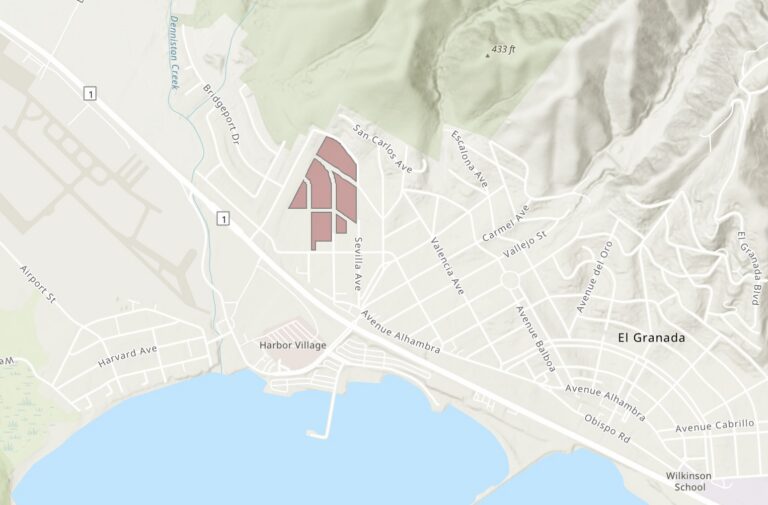
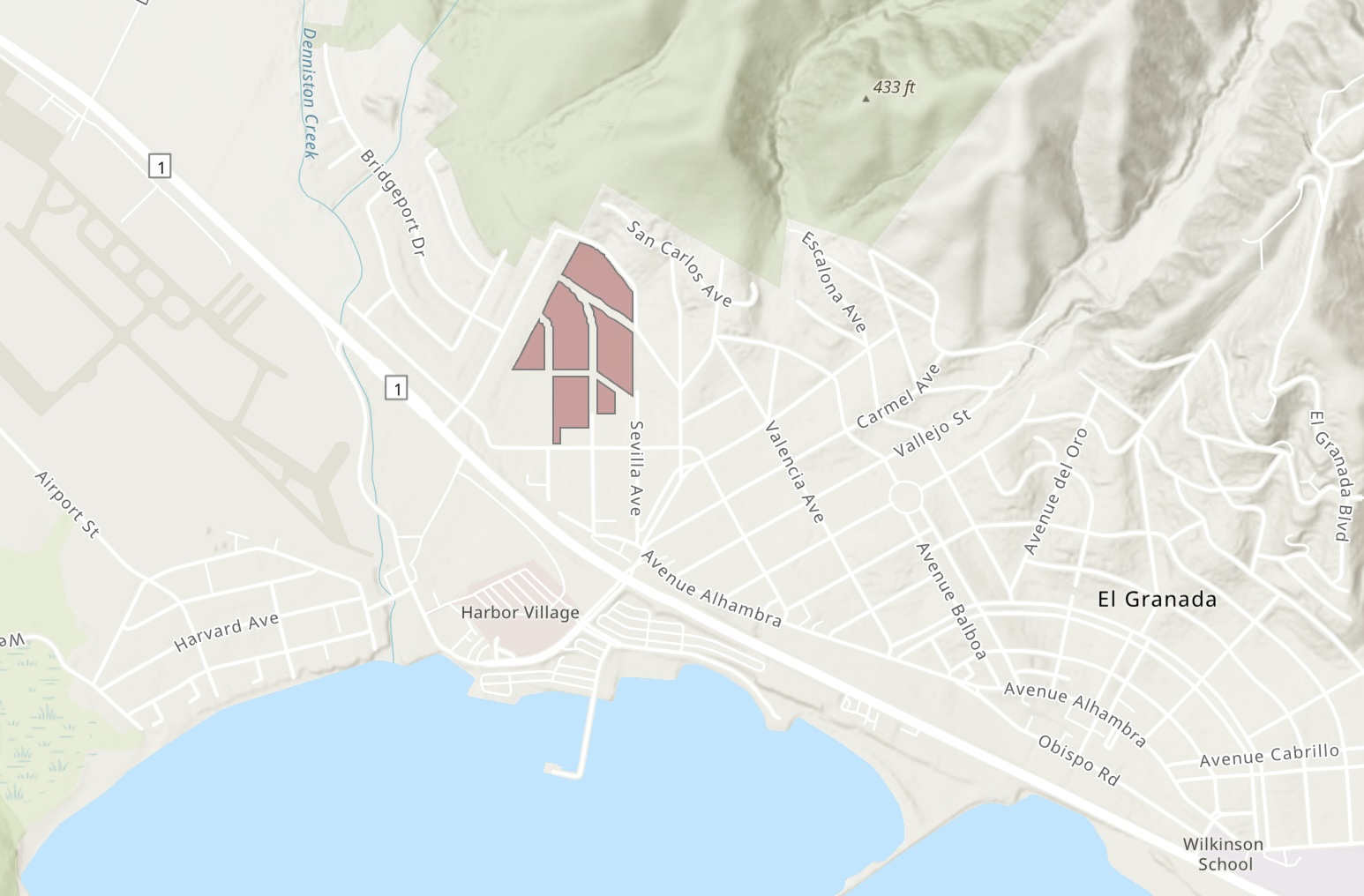
The project location is six parcels between Coral Reef Avenue and Sevilla Avenue in the census-designated coastal community of El Granada, east of Highway 1, within the Coastal Zone in unincorporated San Mateo County, situated on the San Francisco Peninsula. The six parcels included within the project location include the following Assessor Parcel Numbers (APNs): 047-048-150; 047-049-170; 047-051-040; 047-052- 100; 047-053-130; and 047-054-100. The boundaries of the Project area are depicted in Figure 1, attached.
EXISTING CONDITIONS
The Project area includes six parcels on 12.45 acres of currently undeveloped land with young and mature trees, shrubs, and grasses. This Project area is surrounded by residential uses consisting primarily of one- and two-story single-family homes set back from the street. Within this area, water service is provided by the Coastside County Water District, and sewer service is provided by the Granada Community Services District.
Preliminary investigations into the parcels’ biological resources identified wet soil conditions and the presence of wetland vegetation on much of the lower (central and southwestern) portion of the El Granada parcels, which indicate wetlands may be present on these parcels, although a delineation of jurisdictional features is needed to confirm this.
The parcels support a mosaic of native, naturalized, and ornamental vegetation communities typical of the coastal terrace landscape of El Granada. Vegetation communities are irregularly distributed across the parcel, reflecting past disturbance, historical planting, and localized hydrology. Site mapping identified six land cover types within the Project site based on California Department of Fish and Wildlife (CDFW) vegetation classification. Patches of Eucalyptus, Monterey pine and Monterey cypress comprise the majority of vegetation within the parcel and provide suitable overwintering habitat for western monarch butterfly. Two land cover types are potentially considered CDFW sensitive natural communities, and the parcels provide suitable upland habitat and are within the nominal dispersal distance for the federal- and state-listed California red-legged frog. The El Granada parcels also contain suitable habitat for 10 species of California Rare Plant Rank (CRPR) listed plants, Crotch’s bumble bee, special-status and common nesting birds, San Francisco dusky-footed woodrat, and roosting bats.
PURPOSE OF THE EIR
The purpose of an EIR is to inform decision-makers, responsible and trustee agencies, and the public of the environmental impacts of a proposed project that an agency (in this case, the County of San Mateo) may implement or approve. The EIR process is intended to: (1) provide information sufficient to evaluate a project and its potential for significant impacts on the environment; (2) examine methods (e.g., project-specific mitigations, uniformly applied development regulations) of reducing adverse impacts; and (3) consider alternatives to the proposed project that reduce identified potentially significant environmental impacts.
The EIR for the San Mateo County Housing Element Rezoning Program Phase 2 – El Granada will be prepared and processed in accordance with CEQA and will include the following:
A summary of the Project, its potential significant environmental impacts, and mitigation required to avoid or reduce those impacts;
A Project description;
A description of the existing environmental and regulatory setting, potential environmental impacts, and mitigations for the Project;
Alternatives to the proposed Project that reduce identified environmental impacts; and
Other environmental consequences of the Project, including:
– Growth-inducing effects;
– Significant unavoidable impacts;
– Irreversible environmental changes;
– Cumulative impacts; and
– Effects found not to be significant.
CEQA BASELINE
The proposed Project is located in the unincorporated area of San Mateo County. The baseline zoning and land use designation for each of the parcels proposed for rezoning correspond with San Mateo County General Plan land use and zoning designations. Per Section 15125 (e) of the CEQA Guidelines: Where a proposed project is compared with an adopted plan, the analysis shall examine the existing physical conditions at the time the notice of preparation is published, or if no notice of preparation is published, at the time the environmental analysis is commenced as well as the potential future conditions discussed in the plan. In compliance with Section 15125 (e), the Program EIR will use the existing physical development that has been permitted under the unincorporated San Mateo County General Plan land use designations and zoning districts as the baseline existing conditions for CEQA analysis.
PROBABLE ENVIRONMENTAL EFFECTS AND SCOPE OF THE EIR
Programmatic EIR: The County of San Mateo has determined that the proposed Housing Element Rezoning Program Phase 2 – El Granada will require preparation of a Program EIR pursuant to CEQA. The Program EIR will evaluate the environmental impacts resulting from the Project and will recommend mitigation measures to avoid or reduce significant impacts, where applicable. The Program EIR also is intended to help the County review future project proposals pursuant to Section 15168 (Program EIR) of the CEQA Guidelines. The following environmental topics will be evaluated in the EIR:
Aesthetics Mineral Resources Agriculture and Forestry Noise Air Quality Population and Housing Biological Resources Public Services Cultural Resources Tribal Cultural Resources Energy Transportation and Circulation Geology and Soils Utilities and Service Systems Greenhous Gas Emissions Wildfire Hazards and Hazardous Materials Cumulative Impacts Hydrology and Water Quality Alternatives Land Use and Planning
For each of these areas, the EIR will identify whether the proposed Project would cause significant or potentially significant impacts. Where impacts are identified, the EIR will recommend feasible mitigation measures designed to avoid, minimize, or offset those impacts. Of the topics listed above, it is anticipated that the Project will have probable environmental impacts on Aesthetics, Air Quality, Biology, Energy/Greenhouse Gas Emissions, Hydrology and Water Quality, Land Use and Planning, Transportation, Utilities, and Wildfire.
The alternatives analysis will evaluate a reasonable range of project alternatives that, consistent with CEQA, meet most of the project objectives and reduce or avoid any significant environmental effects of the project, including a required No Project Alternative. The EIR will therefore serve as the primary disclosure document for decision-makers, agencies, and the public, ensuring that environmental considerations are fully integrated into the planning and approval process for the Project.
PROJECT SPONSOR/CEQA LEAD AGENCY
County of San Mateo
OTHER PUBLIC AGENCIES WHOSE REVIEW OR APPROVAL IS REQUIRED FOR THE PROPOSED PROJECT
California Coastal Commission has authority to review and approve amendments to the Local Coastal Plan for the El Granada Project area.

More on the CUSD Parcels in El Granada on Coastside Buzz
GCSD Parks Advisory Committee (PAC) Forms Disc Golf Subcommittee to Explore Locations with Public;
GCSD Parks is Asking Would You Like to Have a Disc Golf Course Site on the Coastside?;
San Mateo County Plannning Commission

San Mateo County Board of Supervisors (BoS) Agendas
The Supervisors meet on the 2nd and 4th Tuesdays of the month at 9:00am, as a hybrid meeting.