

|
Getting your Trinity Audio player ready...
|
OWN VOICE. From Gregg Dieguez – SHIFT-Bay Area, Director of Sustainability, March 3rd, 2026.
Subscribe for FREE (or $80/year)! More on SHIFT-Bay Area Substack.
Bay Area transit leaders and advocates have warned of an impending “Transit Doomsday” if voters reject new sales taxes this November. Their message is clear: without additional funding, stations will close, service will be cut, and riders will suffer.
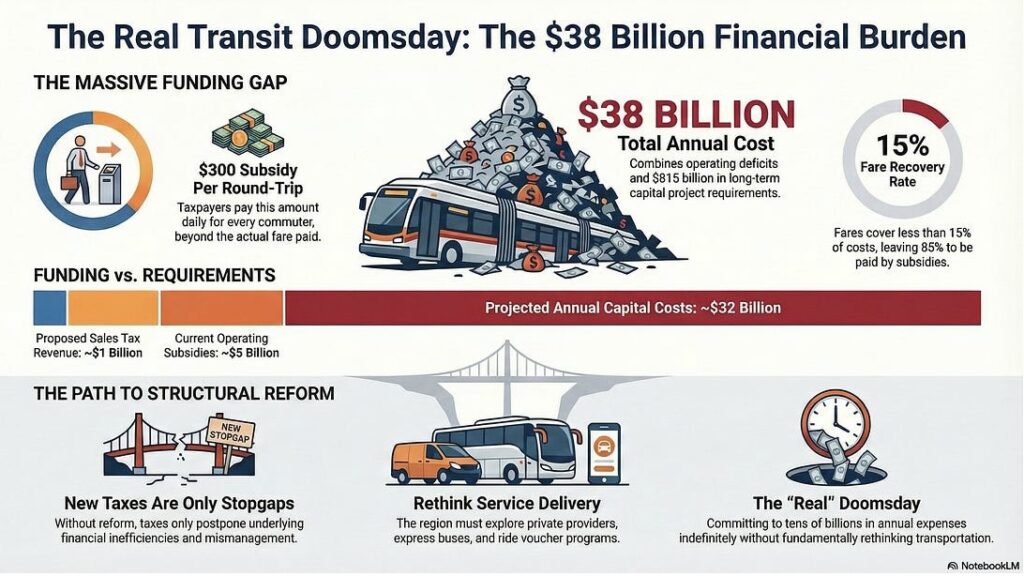
For the relatively small share of residents who depend on transit daily, those disruptions would be real. Regular riders value and rely on these services. But rider fares cover less than 15% of transit operating costs. The remaining 85% is paid by the rest of us – whether we use transit or not.
What has been largely absent from the current public campaign is an honest discussion of the full financial burden of maintaining the existing transit system—and whether better, more efficient alternatives exist.
The True Scale of the Transit Funding Deficit
The proposed sales tax measure, authorized under SB 63, is expected to raise approximately $1 billion per year, increasing with inflation. While this sounds substantial, it addresses only a fraction of the underlying financial gap.
In 2024, the Bay Area’s eight largest transit agencies:
- BART
- San Francisco Municipal Transportation Agency (SFMTA)
- Santa Clara Valley Transportation Authority (VTA)
- Caltrain
- AC Transit
- SamTrans
- Golden Gate Transit
- Sonoma–Marin Area Rail Transit (SMART)
– reported combined subsidies of approximately $5 billion from federal, state, and local sources – including capital contributions. In other words, transit in its current form survives only through massive and ongoing public support. And those subsidies are unlikely to continue given the current Federal Administration and the State’s projected deficits.
The Even Larger Capital Burden Ahead
But covering annual operating losses is only part of the story.
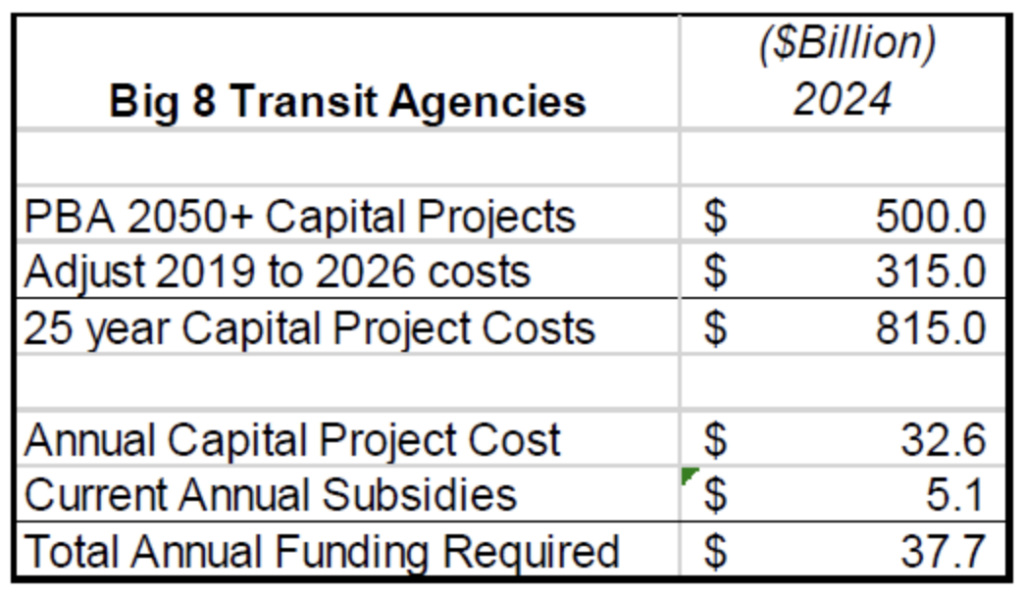
The region’s long-term transportation blueprint, developed by the Metropolitan Transportation Commission and known as Plan Bay Area 2050+, includes approximately $500 billion in planned capital projects.
Those figures are expressed in 2019 dollars. Since then, California construction costs have risen sharply. Adjusted for inflation, the total cost would be approximately $815 billion over 25 years—equal to about $33 billion per year in 2026 dollars.
The Total Annual Cost: $38 Billion
Combining operating deficits and future capital costs produces a staggering figure:
$38 billion per year. Which equals roughly:
- $5,900 per Bay Area resident, per year, or
- $300 in subsidy per day for each of the region’s approximately 500,000 daily round-trip transit commuters, beyond the fares they pay.
These are not one-time expenses. They are recurring, permanent financial commitments that will grow with inflation IF we continue the current inefficient transit approach.
The Questions Voters Are Not Being Asked
Before approving new taxes, voters deserve a full discussion of alternatives and accountability. Key questions include:
- Should transit riders pay a larger share of actual operating costs?
- Should businesses that benefit from worker and customer access contribute more directly?
- To reduce costs, should the region allow greater competition from private providers, such as express buses, vanpools, and emerging autonomous vehicle services?
- Are these proposed projects worth doing? Based on the Bay Area’s transit community’s unbelievable continuing record of major project failures, how can we have any confidence in the benefits of those projects?
- Should subsidies for vulnerable populations be delivered more efficiently through targeted programs, such as ride vouchers?
- Who should oversee the Bay Area Transit system given the failures of the MTC, et al to deal with a 2020 problem until 2026?
- Do cities and counties have more critical infrastructure needs that should be addressed by new sales tax revenue?
These questions go beyond short-term transit funding deficits. They address whether the current transit structure is fiscally sustainable at all.
The Real Risk Facing the Bay Area
The true “Transit Doomsday” is not temporary transit service reductions. It is committing the region to tens of billions of dollars in annual transit expenses indefinitely, without fundamentally rethinking how transportation services are delivered and managed, and whether water, sewer, wildfire, schools, or other needs have higher priority.
The Bay Area must confront difficult but necessary questions:
- What transportation network makes sense for today’s travel requirements?
- Who truly benefits from the system?
- Who should pay?
- And who should manage and operate it?
Without structural reform, new taxes will function only as temporary stopgaps—postponing, rather than solving, the underlying transit financial inefficiencies and mismanagement.
Failing to address these issues now risks locking the region into an increasingly unaffordable future.
_______________________________
All financial figures are drawn from the 2024 Annual Comprehensive Financial Reports of the eight major Bay Area transit agencies listed above. An updated analysis will follow the release of their FY2025 financial statements. As of 3/3/25 4 of the 8 have not been released.

Author: mdrag
x