

|
Getting your Trinity Audio player ready...
|
OWN VOICE. From Bill Softky. Bill grew up in Menlo Park and lives in Montara. Professionally a neuroscientist, physicist, and technologist, he writes the column Tech Turncoat Truths for FairObserver.com.
“We have everything here where California faces the sea, except safety.
The world’s largest waves, the county’s steepest terrain, a two-lane highway often closed.
Tsunami sirens, hurricane-force winds, drenching storms for weeks on end, landslides, rockfalls,
wildfires. Both alpha predators, the great white shark and the mountain lion. Dazzling yellows
and pinks in spring, scrumptious vegetables, the freshest fish and crab possible. Wilderness.
Beautiful sunsets. The Green Flash.
And the kind of people who choose to live here, and among our kind. People who love Nature,
and don’t mind the lack of safety. Choosing to live on the edge makes us different.
All of this stems in some way from local geology.
Here, deep underground, the Pacific and North American tectonic plates collide, making a
seismic wrinkle surfacing East of us in the form of the San Andreas Fault. It traces down Skyline
Boulevard. Slightly askew, the thin granite sliver of Montara (San Pedro) Mountain crumbles
into the sea at Devil’s Slide, like the prow of an icebreaker. That inexhaustable gravel-pile
triumphed over the Coastside Railway over a hundred years ago, and over Caltrans a couple
decades back. In place of their planned high-throughput freeway, Caltrans finally capitulated to
reason, and built the futuristic Lantos Tunnels instead.
Our geology here specifically stems from the general, theoretical geology of physical structures
on planets. The forces shaping our Coastside shape planets everywhere. In that hand-wavy
view based on physics, there are in the whole Universe (ahem) basically three kinds of cliff:
1) Vertical-grained solid rock, like the basalt Devil’s Tower (pics from Wikipedia)
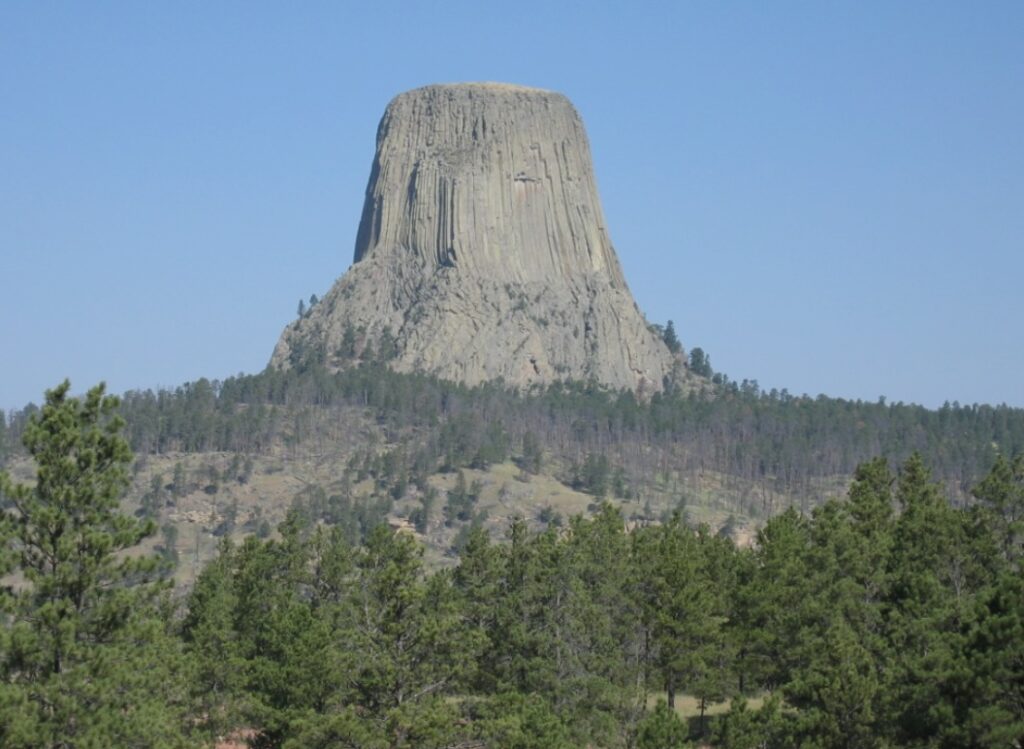
Or Half Dome. The rock wants to cleave along vertical planes.

2) Rock crust over softer ground, like the mesas of the Southwest. The crust protects the softer rock directly under from erosion, but outside that umbrella soft stuff wears off quickly.
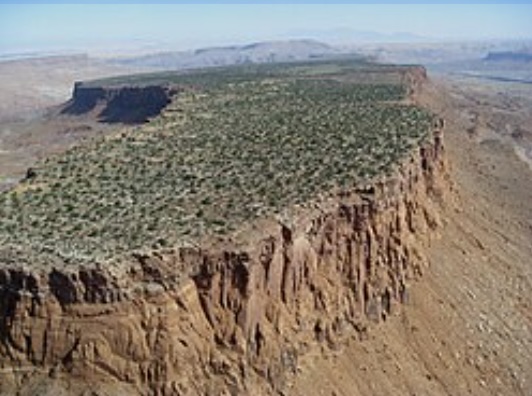
3) Soft earth meets water, like in river canyons, or here on the Coastside. Soft earth is
removed not only by downward rain, but by sideways-slamming surf.
If you were to watch any cliff over the centuries of geologic time, as if in a time-lapse movie,
you would see it racing sideways (compared to smooth hills and valleys, which erode slowly and
thus stay still). But relative to cliff motion in general, hard (and hard-to-erode) rocky cliffs like
those in Yosemite move more slowly (maybe a yard horizontally every century or so, as rockfalls
shave off material). As a general rule soft ground erodes faster, so soft cliffs move faster than
rocky ones….parts of Palos Verdes and Pillar Point can lose yards per year as sandy soil is
pummelled by ocean storms.
I remember hearing from a geologist: If you stand on a cliff looking down at Mother Nature,
she looks back up and says “You’re next.”
The Coastside is actually disappearing, as California actually falls into the sea. Back in the
1970’s my parents pointed out places south of San Gregorio where houses had been replaced
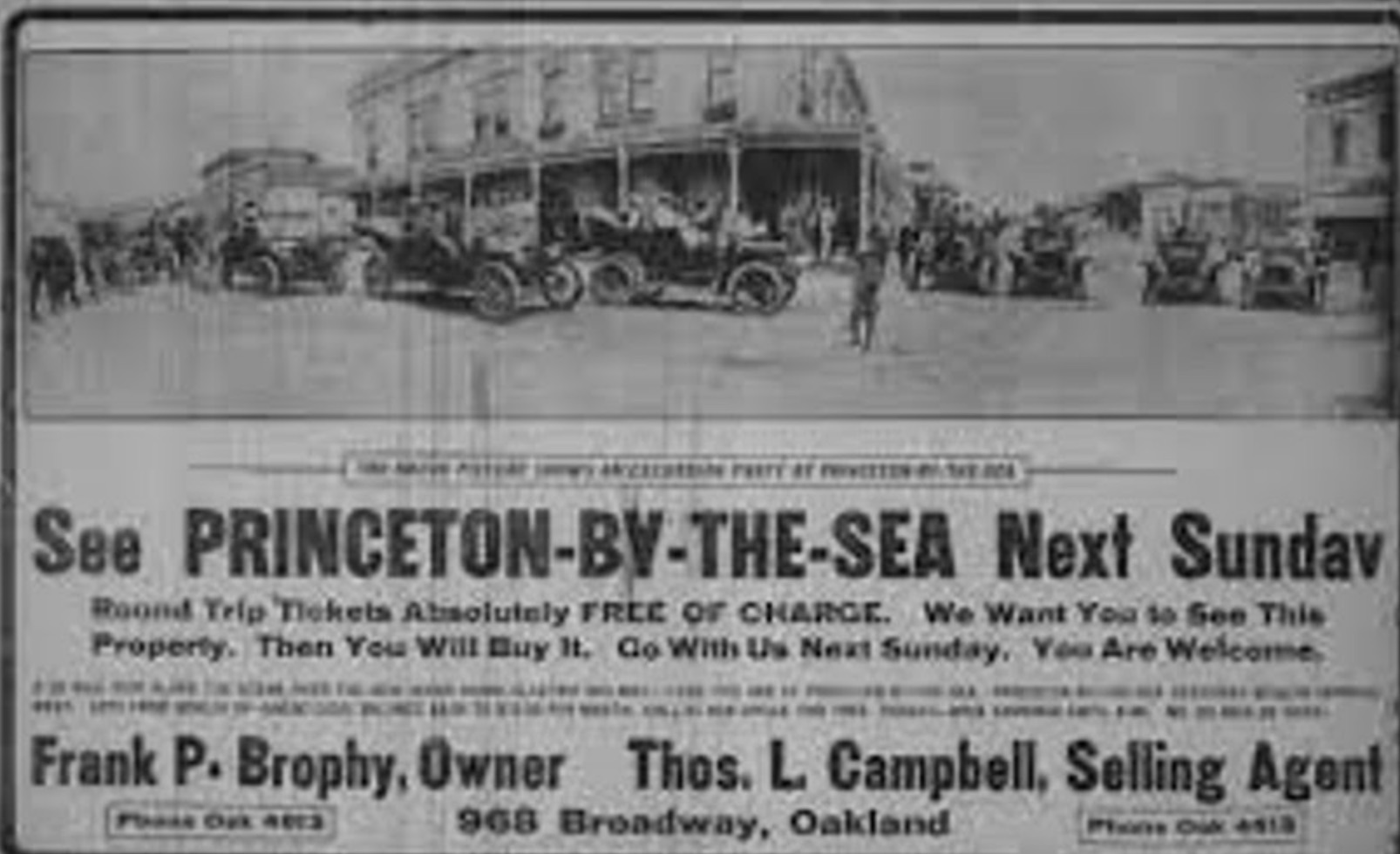
by ocean even earlier. Lots of photographs show huge spans of sand near Princeton Harbor, big
and flat enough for drag races.
Living here on the edge means we only have a single two-lane highway between roadless
mountains and a wild sea. That highway is precarious; a couple years ago it was closed at all
three ends at once for several hours by a boulder, a sinkhole, and a landslide, literally cutting us
off from everywhere else. Fortunately, there is an active emergency-preparedness community
of CERT volunteers and ham radio operators, as trained and organized at Fire Station 40 in
south Half Moon Bay (that’s where I learned about the closure).
Our complete dependence on Highway One presents a double danger and dependence. We
need to prepare for evacuation, so we can’t let it get too clogged. That fact based on physics
alone, absent political opinion, leads to several strong conclusions (which I would love to talk
about with groups in person, where nuance gets through best).
No self-driving cars. “Waymo’s” and their ilk can’t drive in storms, and frequently get stuck for
no apparent reason, like deer blinded by their own headlights. We can’t risk that happening on
our only road out.
No blinding headlights. The new LED headlights really can be blinding, for three reasons: the
tight spacing of dots of light, ultra-high-frequency flickering, and way too much blue light
(which literally blinds our night-vision receptors). We who live and drive here know how
dangerous those headlights are, especially on curvy two-lane roads on cliffs. There must be
some way to stop them!
As little development as possible. Once you realize that both our land area and highway
robustness will always shrink, it’s silly to plan for growth. More people on less land would not
only crush the Coastside’s charm, it would add dangerous traffic delays. Think of how long it
takes already to make a left turn onto Highway One. If traffic were even a little heavier that
turn would take much, much longer. Evacuating ten thousand people would be impossible.
Centralized fire management. We all are at risk from wildfire (my town of Montara especially,
because a hundred acres of dense eucalyptus trees in the middle of town contain more energy
than a nuclear bomb). The physics of wind lets such fires hop ridges and valley in minutes, so
the only sensible solution is fast and large. For example, regions called firesheds (akin to
watersheds) coordinate first-responders across administrative boundaries. To manage
wildfires, centralization (as with Calfire) is a must.
Local water management. The opposite applies to water. The same physics keeping fires aloft
pushes water always downhill. Water doesn’t want to go sideways, it wants to stay in its
watershed, and objects to being pushed uphill. Sewage even more so: it’s heavier, grittier, and
much more dangerous in case of spills. The public-health dangers from raw sewage and
contaminated water are always there, not just in emergencies, meaning administration needs
to be local to keep things running well all the time, and no leaks anywhere. First-responder
speed doesn’t matter nearly as much as knowing the land and the pipes, attention to detail,
and trust. So the same relentless logic telling us to centralize fire administration tells us instead
to localize water and sewage administration. New technology makes such things possible.
The good news is that life on our tiny Coastside strip between ridge and water gives us many
ways to enjoy life:
Cliffs and sunsets draw locals and visitors alike, often for special occasions like wedding
engagements. We often see the “green flash” (an optical effect more subtle than mere
afterimage).
Surfing brings beginners to Surfers’ Beach, and professionals to Mavericks for hundred-foot
waves. Biophysics explains why surfing is so good for people:
https://www.coastsidenews.com/sports/surfing-is-biomechanically-perfect/article_f208afe1-
500e-5e31-9813-3b29089e381b.html.
Extreme sports like mountain biking, surf-skiing, kite surfing, e-foiling. Princeton Harbor seems
to be a hotspot for inventing new ones; I want in.
Local wilderness richer than almost anything in San Mateo county.
(https://coastsidebuzz.com/essay-yes-in-my-front-yard-the-montara-dark-park/ ).
Live music. My wife Criscillia and I frequent two piano bars (Moonraker and Miramar). There
are guitarists playing everywhere, and bars have bands from San Gregorio to Winters.
Coastsiders are fun to be around, even if you aren’t enjoying Nature, or preparing for it.”

Author: mdrag
x
I enjoyed Bill Softky’s “Own Voice” March 7th piece. We are a rugged group of individuals who choose to live here and thrive, despite the lack of some pretty basic needs and services. One can only hope that the Government won’t keep trying to cram more and more human beings into this gem we Coastsiders consider home. As the MidPen Housing 71 rental units are currently under construction, let us hope that they will be rented by people who do not need to commute off the Coastside, because that location lacks adequate public transportation, or ANY school bus service to schools in Half Moon Bay that are 7 miles away (14 vehicle miles traveled round trip), not to mention any nearby Shopping or healthcare or local jobs. That is part of Don Horsley’s legacy to leave us with a flawed “affordable housing complex” that will cost the future residents more to commute from, or even to try to get to and from schools or doctor visits, incentives completed.