

|
Getting your Trinity Audio player ready...
|
DIRECTOR’S REPORT. From the California Coastal Commission meeting on Wednesday, November 4th, 2026. Agenda. North Central Coast District Director’s Report for November 2026: “Emergency CDP: G-2-26-0091, Mirada Road Pedestrian Bridge Erosion Protection (San Mateo County).” Coastal Commissioners.
Permittee: County of San Mateo
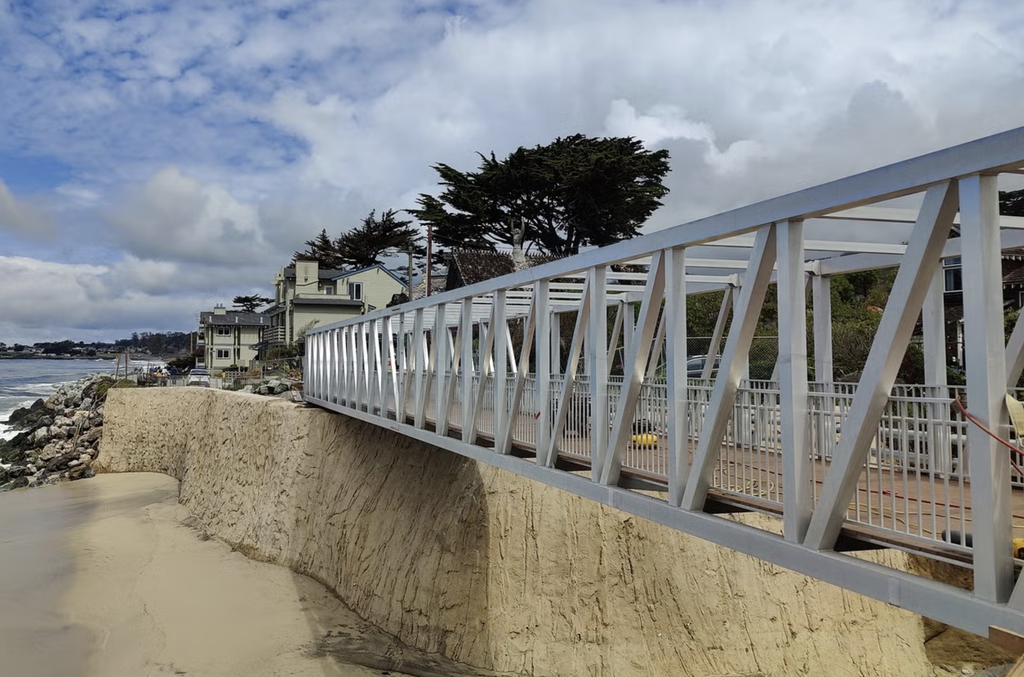
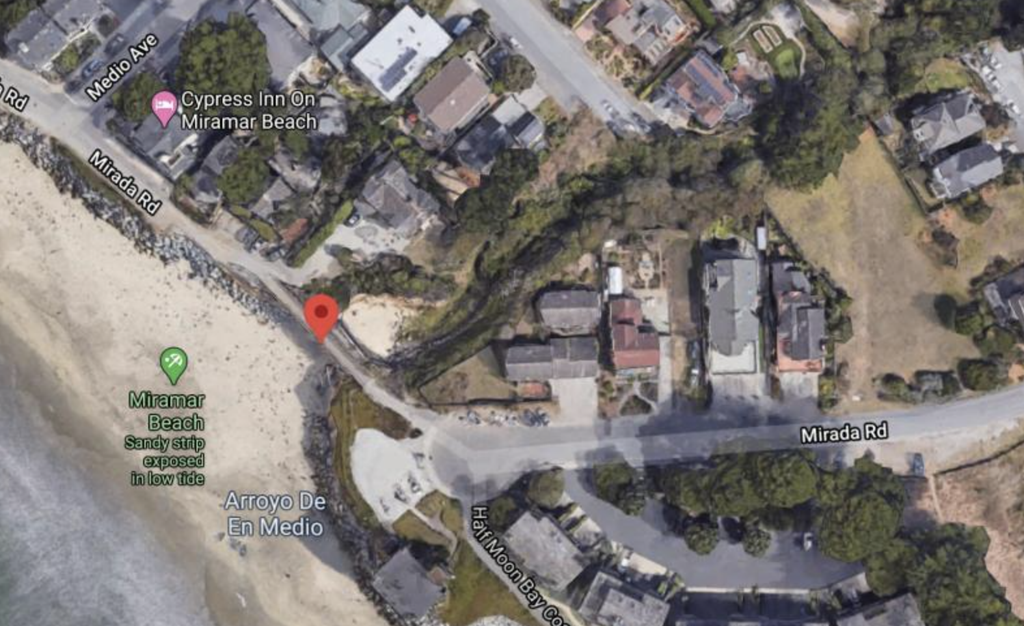
Emergency Location: Existing rock slope protection (RSP) adjacent to the northern terminus of the soil nail wall on the north side of the Mirada Road pedestrian bridge, and the southern terminus of the soil nail wall on the south side of the Mirada Road pedestrian bridge along the bluff and beach adjacent to Mirada Road and the California Coastal Trail where it crosses over Arroyo de en Medio Creek at Half Moon Bay State Beach, straddling portions of the City of Half Moon Bay and the unincorporated Miramar
area of San Mateo County Emergency Description: Storms and associated strong wave action caused damage to existing RSP resulting in exposed bluff at the ends of both soil nail walls, resulting in continued erosion and damage to existing soil nail walls, Mirada Road pedestrian bridge, and associated public infrastructure and coastal access facilities.
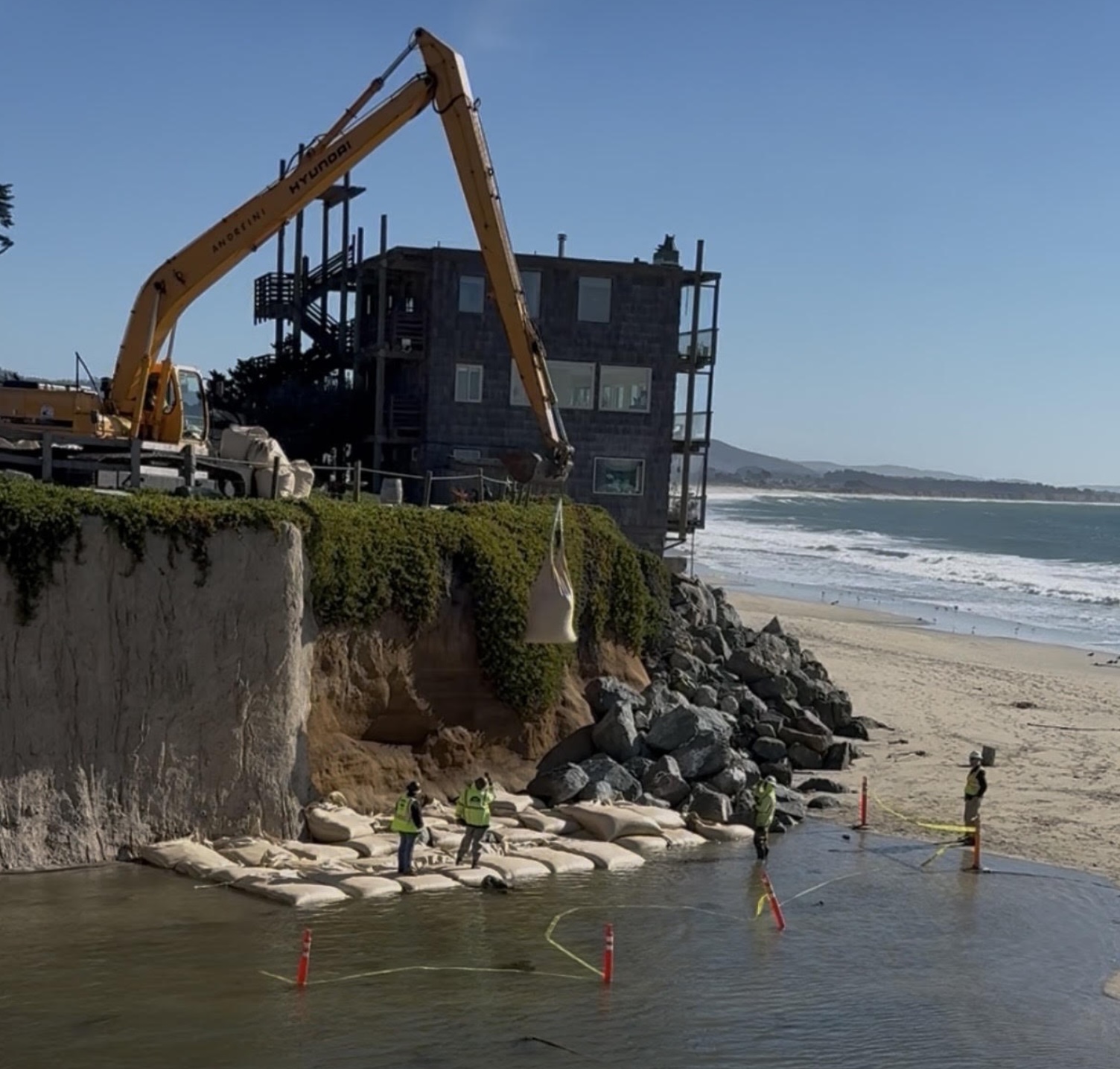
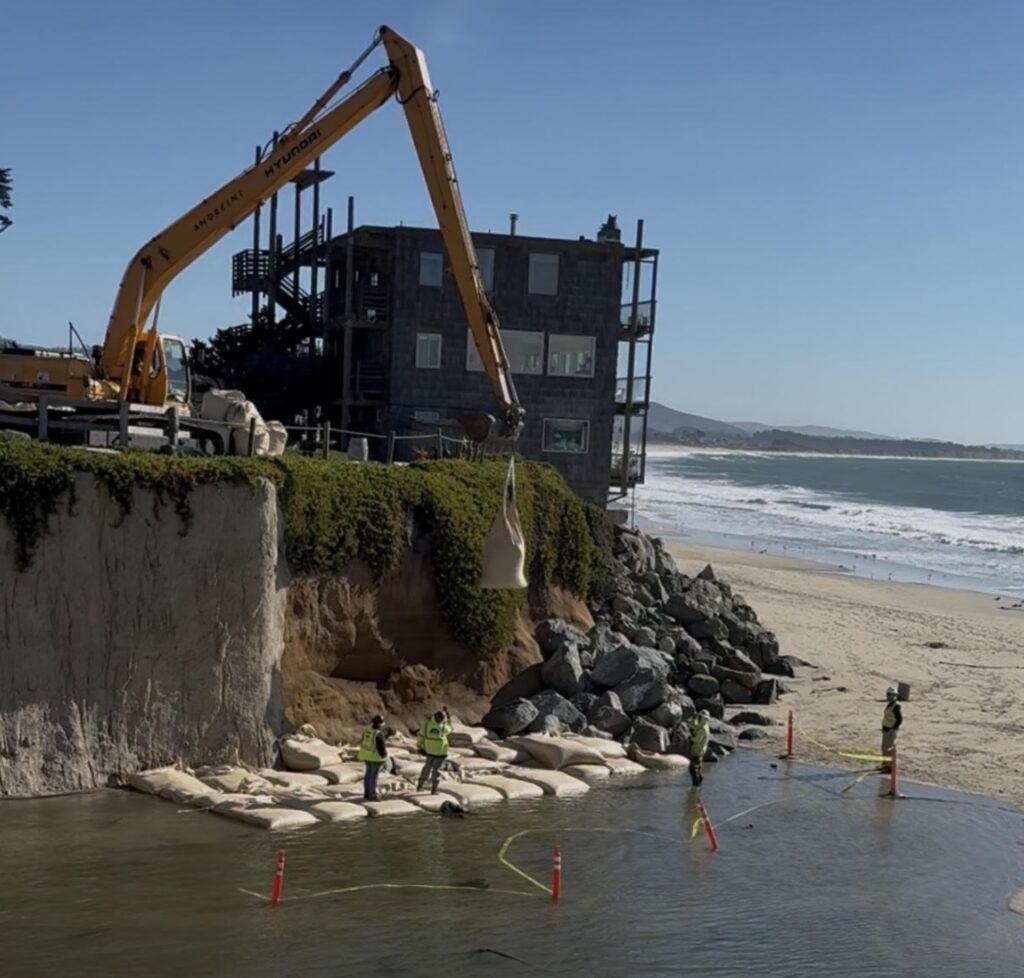
Emergency Development: Installation of approximately 125 large geotextile sandbags at the north and south ends of the existing soil nail walls on each end of the Mirada Road pedestrian bridge. Each sandbag contains approximately 1 cubic yard of virgin marine sand (approximately 1.5 tons) sourced from the San Francisco Bay and will be placed within the existing RSP footprint to protect the exposed bluff faces. The sandbags will be stacked at an approximately 1.5H:1V slope. To facilitate placement,
existing riprap will be adjusted only to the extent necessary to create a relatively flat and stable surface for installation of the sandbags.
Executive Director’s Determination
The Executive Director of the California Coastal Commission hereby finds that: (a) a sudden unexpected occurrence demanding immediate action to prevent or mitigate loss or damage to life, health, property or essential public services exists (i.e., an “emergency” (see Title 14 California Code of Regulations Section 13009 and California Coastal Act (Public Resources Code) Section 30624); (b) the emergency requires
action more quickly than allowed by the procedures for regular CDPs; (c) the emergency development can and will be completed within 30 days unless otherwise specified by the terms of this ECDP; (d) the emergency development carried out under this ECDP is considered temporary work done in an emergency situation to abate an emergency and is undertaken at Permittee risk; (e) a regular CDP must be obtained for the emergency development to become more than temporary emergency abatement and/or if the Permittee wishes to expand the scope of work beyond that authorized by this ECDP; (f) absent obtaining a regular CDP, the emergency development shall be removed and the affected area restored; and (g) Commission staff will review public comment on the proposed emergency development as time allows.
Conditions of Approval
- The enclosed ECDP acceptance form must be signed by the Permittee and returned to the California Coastal Commission’s North Central Coast District Office within 15 days of the date of this ECDP (i.e., by November 6, 2026). This ECDP is not valid unless and until the acceptance form has been received in the North Central Coast District Office.
- All emergency development shall be limited in scale and scope to that specifically identified in the Emergency Permit Application Form dated received in the Commission’s North Central Coast District Office on October 15, 2026. Only that emergency development specifically described in this ECDP and for the specific location listed above is authorized. Any other development requires separate authorization from the Executive Director or the Commission, as applicable.
- The emergency development authorized on a temporary basis by this ECDP must be completed within 30 days of ECDP issuance (i.e., by November 21, 2026).
- This ECDP does not obviate the need to obtain necessary authorizations and/or permits from other agencies (e.g., City of Half Moon Bay, California State Lands, California Department of Fish and Wildlife, U.S. Fish and Wildlife Service, U.S. Army Corps of Engineers, etc.). The Permittee shall submit to the Executive Director copies of all such authorizations and/or permits upon their issuance.
- By exercising this ECDP, Permittee acknowledges and agrees that: (a) the emergency development is temporary, is designed to temporarily abate the emergency, and shall be removed unless and until a regular CDP authorizing the work is approved, and provided the Permittee adheres to such regular CDP’s terms and conditions; and b) a regular CDP is subject to all of the provisions of the
California Coastal Act (as codified in Sections 30000 to 30900 of the Public Resources Code) and any applicable Local Coastal Program (LCP) policies and may be conditioned accordingly to avoid and/or to offset coastal resource impacts consistent with the Coastal Act (and LCP as applicable) (including but not limited to requirements for public access provisions (such as offers to dedicate, easements, inlieu fees, etc.), assumption/disclosure of risks (including deed restrictions), triggers
for relocation/removal, offsetting mitigations, etc.). The Permittee acknowledges that review of the CDP application to determine consistency with the Coastal Act (and LCP as applicable) will be based on the conditions the property was legally in prior to initiation of the temporary emergency development that is the subject of this ECDP. - By exercising this ECDP, the Permittee acknowledges and agrees in relation to this ECDP and the emergency development that it authorizes: (a) to assume all risks (including all coastal hazard risks, that include but are not limited to episodic and long-term shoreline retreat and coastal erosion, high seas, ocean waves, tidal scour, storms, tsunami, coastal flooding, landslide, earth movement, and the interaction of all of these, many of which will worsen with future sea level rise); (b) to unconditionally waive any claim of damage and/or liability against the Commission and/or its officers, employees, agents, successors and/or assigns; (c) to indemnify and hold harmless the Commission and its officers, employees, agents, successors and/or assigns against any and all liability, claims, demands, damages, costs (including costs and fees incurred in defense of such claims), expenses, and amounts paid in settlement, including as it relates to any damages to public and/or private properties and/or personal injury; (d) that any adverse effects to property or people caused by the emergency development shall be fully the responsibility of the Permittee.
- The Permittee shall reimburse the Commission in full for all Commission costs and attorneys’ fees (including but not limited to such costs/fees that are: (a) charged by the Office of the Attorney General; and/or (b) required by a court) that the Commission incurs in connection with the defense of any action brought by a party other than the Permittee against the Commission, its officers, employees, agents, successors and/or assigns challenging the approval or issuance of this ECDP, the interpretation and/or enforcement of ECDP terms and conditions, or any other matter related to this ECDP. The Permittee shall reimburse the Commission within 60 days of being informed by the Executive Director of the amount of such costs/fees. The Commission retains complete authority to conduct and direct the defense of any such action against the Coastal Commission, its officers, employees, agents, successors and/or assigns.
- Within 120 days of ECDP issuance (i.e., by February 19, 2027), the Permittee shall either: (a) remove all of the materials placed or installed in connection with the emergency development, and restore all affected areas to their prior condition or better, all subject to Executive Director review and approval (and, in some cases, if directed by the Executive Director, subject to a regular CDP); or (b) submit a complete application (i.e., satisfying the requirements of Title 14 California Code of Regulations Section 13056) for a regular CDP to authorize the emergency development (or for an eventual different project designed to address the emergency development and long-term solutions to address damage of the Mirada Road pedestrian bridge and associated infrastructure from storms and wave action), including submitting all information and materials requested, and as directed, by the Executive Director if/when the Executive Director determines that such application is incomplete. If such regular follow-up CDP application is withdrawn by the Permittee, or is denied by the Commission, or if it remains incomplete for a period of 120 days after the Executive Director informs the Permittee that the application is incomplete, then all of the materials placed and/or installed in connection with the emergency development shall be removed, and all affected areas shall be restored to their prior condition or better, all subject to Executive Director review and approval (and, in some cases, if directed by the Executive Director, subject to a regular CDP)
- Failure to meet any of the applicable requirements of Condition 8 above shall constitute a knowing and intentional violation of the Coastal Act and may result in formal enforcement action by the Executive Director and/or the Commission. Such formal action may include: recordation of a Notice of Violation on the Permittee’s property; the issuance of a Cease and Desist Order and/or a Restoration Order; imposition of administrative penalties of up to $11,250 per day per violation; a civil lawsuit (that may result in the imposition of monetary penalties, including daily penalties of up to $15,000 per violation per day); and/or other applicable penalties and relief pursuant to Coastal Act Chapter 9. In addition, failure to follow and meet all terms and conditions of this ECDP shall also constitute a knowing and intentional Coastal Act violation to which the same actions above may be applied.
- 10.All emergency development shall be limited to the least amount necessary to temporarily abate the emergency, and shall be undertaken in a time and manner that avoids any and all coastal resource impacts as much as possible, including avoiding impacts to public access. The Permittee shall keep the Executive Director informed regarding emergency development progress, including in terms of any issues encountered that may require adjustment.
- A licensed civil engineer with experience in coastal structures and processes shall oversee all construction activities and shall ensure that all emergency development is limited to the least amount necessary to temporarily abate the emergency consistent with the terms and conditions of this ECDP.
- All emergency construction activities shall limit impacts to coastal resources (including public recreational access and the Pacific Ocean) to the maximum extent feasible including by, at a minimum, adhering to the following construction requirements:
a.) Construction activities shall be limited to no more than a total of 30 days and shall take place on non-holiday weekdays to the maximum extent feasible.
b.) All construction activities shall take place during daylight hours (i.e., from one hour before sunrise to one-hour after sunset). Lighting of the beach and/or intertidal area is prohibited.
c.) Construction work and equipment operations: shall avoid areas seaward of the tidal extent as much as possible; shall be prohibited in ocean waters and/or wetted sand (i.e., areas either wet and/or with a noticeable sheen from tidal and/or wave action); and shall avoid beachgoers and beach recreational areas as much as possible.
d.) Any grading of or in intertidal areas shall be prohibited.
e.) Any construction materials and equipment placed on the beach during daylight construction hours shall be stored beyond the reach of tidal waters. All construction materials and equipment shall be removed in their entirety from the beach area by one-hour after sunset each day that work occurs.
f.) All construction areas shall be minimized and demarked by temporary fencing designed to allow through public access and protect public safety to the maximum extent feasible, where such areas shall be limited in their spatial extent as much as possible. Construction (including but not limited to construction activities, and materials and/or equipment storage) is prohibited outside of the defined construction, staging, and storage areas.
g.) The construction site shall maintain good construction site housekeeping controls and procedures (e.g., clean up all leaks, drips, and other spills immediately; keep equipment covered and out of the rain (including covering exposed piles of soil and wastes); dispose of all wastes properly, place trash receptacles on site for that purpose, and cover open trash receptacles during wet weather; remove all construction debris from the beach; etc.).
h.) All construction activities that result in discharge of materials, polluted runoff, or wastes to the beach or the adjacent marine environment shall be prohibited. Equipment washing, refueling, and/or servicing shall not take place on the beach. Any erosion and sediment controls used shall be in place prior to the commencement of construction as well as at the end of each workday.
i.) All areas impacted by construction activities shall be restored to their preconstruction condition or better within three days of completion of construction. Any beach sand that is impacted by construction shall be filtered as necessary to remove any construction debris.
j.) All contractors shall ensure that work crews are carefully briefed on the importance of observing the construction precautions given the sensitive work environment. Construction contracts shall contain appropriate penalty provisions sufficient to offset the cost of retrieval/cleanup of foreign materials not properly contained and/or remediation to ensure compliance with this ECDP otherwise. - The Permittee shall notify planning staff of the Coastal Commission’s North CentralCoast District Office immediately upon completion of construction. If planning staff should identify reasonable restoration measures, such measures shall be implemented immediately.
- Copies of this ECDP shall be maintained in a conspicuous location at the construction job site at all times, and such copies shall be available for public review on request. All persons involved with the construction shall be briefed on the content and meaning of this ECDP, and the public review requirements applicable to it, prior to commencement of construction.
- Within 30 days of completion of construction authorized by this ECDP, the Permittee shall submit site plans and cross sections to the Executive Director clearly identifying all development completed under this emergency authorization (comparing the legal pre-emergency development condition to both the emergency condition and to the post-emergency development condition), and a narrative description of all emergency development activities undertaken pursuant to this ECDP. Photos showing the project site before the emergency (if available), during emergency development construction activities, and after the work authorized by this ECDP is complete shall be provided with the site plans and cross sections.
- A construction coordinator shall be designated to be contacted during construction should questions arise regarding the construction (in case of both regular inquiries and emergencies), and the construction coordinator’s contact information (i.e., address, email, phone numbers, etc.) including, at a minimum, an email address and a telephone number (with voice mail capabilities) that will be made available 24 hours a day for the duration of construction, shall be conspicuously posted at the job site where such contact information is readily visible from public viewing areas, along with indication that the construction coordinator should be contacted in the case of questions regarding the construction (in case of both regular inquiries and emergencies). The construction coordinator shall record the contact information (e.g., name, address, email, phone number, etc.) and nature of all complaints received regarding the construction, and shall investigate complaints and take remedial action, if necessary, within 24 hours of receipt of the complaint or inquiry. The Permittee shall submit the record of complaints/inquiries and actions taken in response to the Executive Director on a weekly basis, and upon completion of construction activities.
- Minor adjustments to the requirements above, including deadline adjustments, may be allowed by the Executive Director if the Executive Director determines that such adjustments: (a) are deemed reasonable and necessary to help to temporarily abate the identified emergency, including as emergency conditions may change; (b) are designed to avoid coastal resource impacts (and limit those that are unavoidable) as much as possible; and (c) in the case of deadline extension adjustments, are appropriate in light of circumstances, including that the Permittee has shown diligence in pursuing the emergency development and meeting all ECDP terms and conditions.
- By exercising this ECDP, Permittee acknowledges and agrees that this ECDP shall not constitute evidence against and/or a waiver of any public rights which may exist on the property.
- The Permittee shall disclose this ECDP, including all of its terms and conditions, to any prospective buyer of the affected property during the period of time that any development that is the subject of this ECDP remains on such property.
- Failure to comply with the terms and conditions of this ECDP may result in enforcement action under the provisions of Coastal Act Chapter 9. The issuance of this ECDP does not constitute admission as to the legality of any development undertaken on the property without a CDP and shall be without prejudice to the California Coastal Commission’s ability to pursue any remedy under Coastal Act Chapter 9.
If you have any questions about the provisions of this ECDP, please contact the Commission’s North Central Coast District Office at 455 Market Street, Suite 300, San Francisco, CA 94105; northcentralcoast@coastal.ca.gov; and/or (415) 904-5260.
More on the Mirada Bridge on Coastside Buzz

Author: mdrag
x