
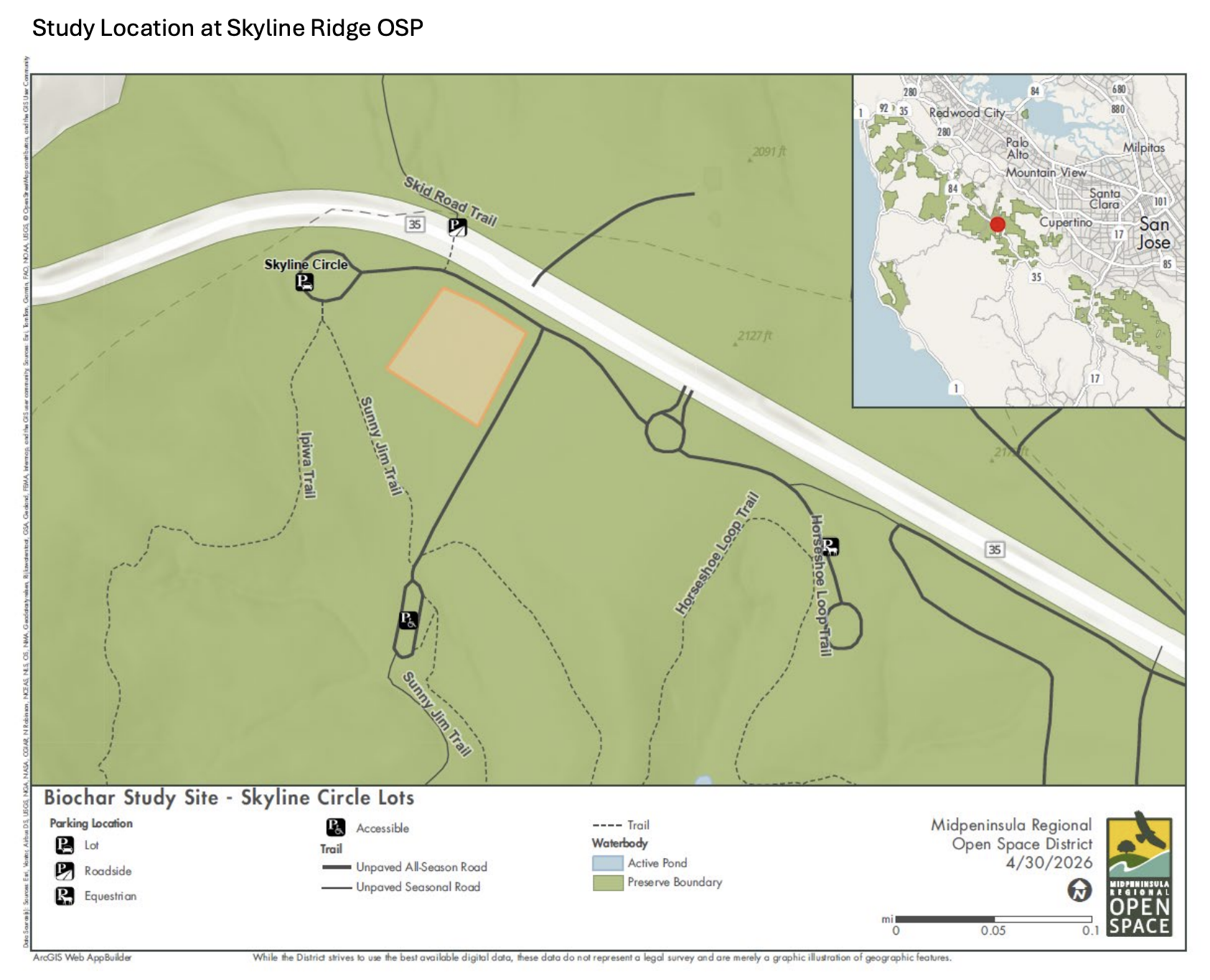
CONSENT AGENDA. From Midpenisula Regional Open Space District (Midpen) regular board meeting on Wednesday, June 10th, 2026 at 7:00pm, as a hybrid meeting. Agenda. Staff report for Item #5: “Contract Amendment with Creekside Center for Earth Observation for the Study of Biochar Effects to Grassland Ecosystems”.
Authorize the General Manager to amend a contract with Creekside Center for Earth Observation
in the amount of $39,989, with an additional 10% ($6,575) in contingency funds, to revise the
study plan for a new study site and conduct preliminary site surveys and soil testing, bringing the
contract to a new total amount of $72,330.
Discussion
On December 1, 2023, Midpeninsula Regional Open Space District (District) entered into an
agreement with Creekside Center for Earth Observation (Creekside) under the General
Manager’s authority for a not-to-exceed amount of $19,982, later amended to a not-to-exceed
amount of $25,766, to conduct a biochar study for informing carbon resilient land management
practices. The purpose of the study is to investigate the effects of amending grassland soils with
biochar – a relatively inert, carbon-rich substance similar to charcoal – as a potential mechanism
for increasing carbon sequestration in grassland ecosystems.
Resource Management Policy XVI – Climate Change directs the District to “Increase carbon
sequestration in vegetation and soils,” including to “evaluate, study, and implement additional
land management strategies” for this specific goal and purpose. Biochar has demonstrated
benefits as a soil amendment in agriculture and has been well-studied in that context. However,
studies in wildland or restoration contexts are rare and the effects on California grassland native
vegetation and soil types are not well understood. Therefore, the District is developing a study to
examine the effects at a previously disturbed site to determine if biochar can be safely applied in
native natural areas. The study will measure the response of native vegetation, soil chemistry,
and soil structure to the application of biochar. Results of the study will inform whether the
District should consider applying biochar in the future to grasslands, or whether it should only be
considered for highly disturbed areas such as disk-line restorations.
In Phase I of this project, Creekside developed a study design, including a five-year monitoring
plan, for a site at Rancho San Antonio County Park (site is currently managed under a timelimited agreement by the District). This study site was selected due to its heavily disturbed and
flat condition, with low risk if the biochar application resulted in negative effects. The site was approved by Santa Clara County Parks (County) prior to commencing the study design in 2023.
At the time, it was anticipated that the District and the County would seamlessly enter into a
new, multi-year management agreement for managing Rancho San Antonio County Park.
Currently, the District is under a short-term 1-year agreement, which was extended for one
additional year ending on June 30, 2027. Although negotiations are underway, it is unclear as of
the writing of this report whether an extension or new, similar management agreement will be
possible. Given the uncertainty regarding the long-term management of the site, it is prudent to
switch the study location to accommodate its five-year monitoring period, which is necessary to
understand the long-term effects of a biochar application.
In fall 2025, a new study site was identified adjacent to the Skyline Ridge Open Space Preserve
“Circle Lot” (Attachment 1). In addition to the benefit of District ownership, the Skyline Ridge
location includes soils and vegetation more representative of other District grasslands, which will
make the results of the study more broadly informative to future biochar projects. The
differences between the Skyline Ridge and Rancho San Antonio site, such as slope and soil
conditions, necessitate adjustments to the study design, soil testing and vegetation surveys. Thus,
an amendment to the contract is needed to revise the details of the study.
The proposed contract amendment for $39,989 plus $6,575 in contingency will allow the
consultant to revise the study design and apply the design to the new site. This is a larger cost
than the original study design because new soil testing and vegetation surveys are more extensive
at the new site given the greater variety of soil types and vegetation present.
More on Midpen Open Space on Coastside Buzz


Author: mdrag
x