
|
Getting your Trinity Audio player ready...
|
PRESS RELEASE. From Cabrillo Unified School District on April 24th, 2026.
Dear Cabrillo Unified Families and Community Members,
As many of you are aware, a few months ago, on February 9th, 2026 our Coastside community suffered a terrible tragedy when a 16-year-old resident lost his life in a traffic accident near the intersection of
Highway 1 and Terrace Avenue. The device involved was an eMoto, a type of electric motorcycle that
has become increasingly common among young riders in our community. While this young person
was not a student in our district, he was a member of our community — and his loss continues to be
felt deeply by all of us. Our thoughts remain with his family, his friends, and everyone touched by this
tragedy.
A Growing Crisis for Our Young People
This heartbreaking loss is not an isolated event. Rady Children’s Hospital in San Diego reported
treating just one pediatric e-bike patient in 2021. By 2025, that number had risen to 201 — a
staggering increase that physicians have described as a growing pediatric public health crisis. In
California, reported e-bike collisions rose from 184 in 2018 to more than 3,400 in 2023. Medical
experts, including the American College of Surgeons, have issued formal statements recognizing that
we are essentially allowing children to ride vehicles that behave far more like motorcycles than
bicycles — at speeds that even trained professional cyclists require years of experience to handle
safely.
What Parents Need to Know About the Law
California law defines three classes of legal e-bikes (Class I, II, and III), each with specific speed
limits, age requirements, and rules about where they may be ridden. All legal e-bikes must have a
motor of 750 watts or less, working pedals, and safety features that prevent speeds above the class
limit. Helmets are required by California law for all riders under 18. For a full explanation of each class and its restrictions, we encourage families to review the San Mateo County Office of Education’s E-
Bike Handbook, published in partnership with the San Mateo County Transportation Authority and the California Office of Traffic Safety.
The critical point for parents: Many devices being marketed to young people as “e-bikes” are, in
fact, illegal electric motorcycles. Understanding this distinction could save your child’s life.
The “eMoto” Problem: What Many Parents Don’t Realize
Many devices currently being sold — online and in stores — are labeled as “Class 2” e-bikes but are
actually capable of speeds of 30, 35, or even 40+ miles per hour. These are not legal e-bikes. Under
California law, they are electric motorcycles, and a growing number are specifically what the state
now classifies as “eMotos” — off-highway electric motorcycles.
Effective January 1, 2026, California Senate Bill 586 formally defines an “off-highway electric
motorcycle” or “eMoto” as a vehicle designed primarily for off-highway use, powered by an electric
motor, with handlebars, a straddle seat, two wheels, and no manufacturer-provided pedals. These
devices are now classified as off-highway motor vehicles and are subject to all the same rules and
regulations, including a requirement that operators wear a Department of Transportation (DOT)
approved helmet and that the vehicle display a DMV-issued identification plate.
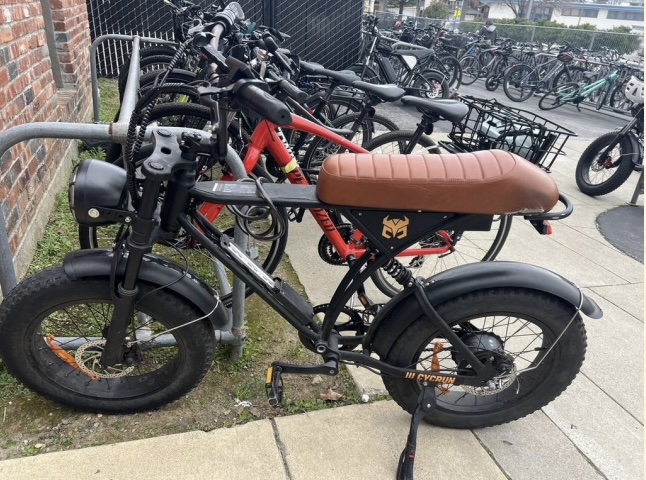
Many of the devices we see students riding to and from our schools fall into this category. Popular
brands market and sell these devices as e-bikes, sometimes providing apps or simple codes that
allow riders to bypass speed limiters and reach speeds well over 30 mph. Regardless of how they are
labeled or marketed, if a device can exceed 20 mph using a throttle, it is not a legal e-bike in
California. Operating one on public roads requires DMV registration, proper motorcycle lighting and
mirrors, and a valid driver’s license with an M1 or M2 classification.
Parents Should be Aware of the Following
It is illegal for a minor without a proper license to operate an electric motorcycle on any public road,
sidewalk, or bike path. Under a new law also effective January 1, 2026 (Assembly Bill 875), law
enforcement is now authorized to impound for at least 48 hours any electric vehicle that does not
meet the legal definition of an e-bike, can travel over 20 mph, and is being operated by an unlicensed
individual. A safety course may be required as a condition of the vehicle’s release when the operator
is a minor. Parents may also be held legally and financially liable if their child is involved in a crash
while operating an unregistered electric motorcycle.
We strongly encourage every parent to check the manufacturer’s website for any electric device their
child currently rides and determine its actual top speed capability and motor wattage. If it exceeds 20
mph on throttle or has a motor over 750 watts, it is not a legal e-bike — and your child should not be
riding it on public roads without proper licensing and registration.
Additional New Laws Effective in 2026
Two additional laws that took effect on January 1, 2026, are important for families to be aware of:
Assembly Bill 544 now requires that all e-bikes be equipped with a red reflector or a solid or flashing
red light with a built-in reflector on the rear during all hours of operation — not just during darkness as
was previously required. This law also allows the CHP-developed online e-bike safety and training
program to fulfill the safety course requirement for minors who receive a helmet violation.
Senate Bill 1271 establishes new safety standards for e-bike batteries, charging systems, and related
components. These devices must now be tested by accredited laboratories to meet specific safety
standards and must be labeled to show compliance. This law aims to reduce risks of fire, explosion,
and electrical malfunction — serious hazards associated with lithium-ion batteries, particularly in
lower-cost e-bikes purchased online.
Resources for Families
San Mateo County Office of Education E-Bike Handbook — A comprehensive guide
covering e-bike classifications, California law, safety tips, and maintenance. We strongly
encourage every family to review this resource.
CHP E-Bike Safety Training — An approximately one-hour online course highly
recommended for all youth e-bike riders. Youth are encouraged to complete it with an adult,
and a certificate is available upon completion. This course also satisfies the safety course
requirement for minors cited for helmet violations.
Safe Routes to School, Marin County — Additional e-bike education resources for parents, students, and school administrators at www.saferoutestoschools.org/education/e-bike- education/
Looking Ahead: District Action
In light of this tragedy and the broader public safety concerns surrounding electric bikes and electric
motorcycles in our community, the Cabrillo Unified Board of Education and district staff will be
undertaking a comprehensive review of district policies related to e-bikes and electric mobility devices
on and around our school campuses. This review will consider the approaches being adopted by
other districts in San Mateo County — including policies that restrict throttle-equipped devices on
school grounds — and will draw on recommendations from the San Mateo County Office of
Education’s E-Bike Collaborative and guidance from law enforcement.
We anticipate bringing a proposed updated Board policy to the Board of Education for discussion in
the coming weeks and will communicate any new expectations to families well in advance of
implementation.
The San Mateo County Sheriff’s Office is committed to continued education and enforcement of
existing laws regarding electric bikes and electric motorcycles in our Coastside community. The new
impoundment authority under AB 875 provides law enforcement with an important additional tool, and
we encourage any community member who observes unsafe or unlawful operation of these devices to
report it to the Sheriff’s Office by calling 650-363-9411.
A Shared Responsibility
Keeping our children safe is a responsibility we all share — as parents, educators, law enforcement,
and community members. We ask every family to have a direct and serious conversation with their
children about e-bike and e-motorcycle safety, the laws that govern these devices, and the very real
consequences of riding without proper equipment, training, and legal compliance.
For questions or comments related to our Safe Routes to School program, please contact Carlene
Foldenauer at FoldenauerC@cabrillo.k12.ca.us.
No device, no matter how exciting, is worth a child’s life.
With deepest sympathy and resolve,
Ramon Miramontes, Superintendent, Cabrillo Unified School District
Ken Binder, San Mateo County Sheriff
Eamonn Allen, San Mateo County Sheriff’s Office Captain, Coastside Patrol Bureau

Author: mdrag
x