

|
Getting your Trinity Audio player ready...
|
ARTICLE. From SHIFT-Bay Area on August 7th, 2025, written by Montara resident, Gregg Dieguez. We’re a nonpartisan policy group focused on Sustainability in Housing, Infrastructure, Finance, and Transportation (SHIFT). We promote effective, efficient, sustainable governance rooted in democratic values and principles.
Senate Bill 63 in California (2025-2026 session) authorizes a regional transportation revenue measure for the San Francisco Bay Area. Specifically, it allows for a retail transactions and use tax to be placed on the ballot in Alameda, Contra Costa, and San Francisco counties, with potential opt-in for San Mateo and Santa Clara counties. The bill establishes a Transportation Revenue Measure District governed by the Metropolitan Transportation Commission (MTC)
The True Cost of Transit…It’s so much worse than you think
Senate Bill 63 is winding its way through the legislature. It would add more taxes in the Bay Area to try and keep legacy transit afloat without requiring legacy transit to make any hard decisions to make itself more financially sustainable.
San Mateo County has the option to join the SB63 tax or go its own way. But whether you live in San Mateo County or not, it’s a good idea to understand better just how bad the situation is with transit costs. In this article, we’ll look at some high-level reasons why San Mateo County should not strap itself to the Traditional Transit Titanic.
Traditional transit is a sinking ship for good reasons that are not solved by this tax increase. Instead, what should be pushed for are efficiencies in the current bloated bureaucracies and a transition to the emerging agile and affordable transit alternatives, including mini-busses, ride-sharing, and autonomous electric vehicles.
The Real Fiscal Issue: Inefficiency
What has not been presented by staff reports to local agency boards is the full context of Traditional Transit cost (in)efficiency in the Bay Area, including San Mateo County. A review of the 6/30/2024 financial performance of 8 major Bay Area Transit Agencies shows that they are massively inefficient compared to emerging alternatives. On average, Bay Area Transit services are 6 times more expensive than an EV, and do not deliver door to door service.
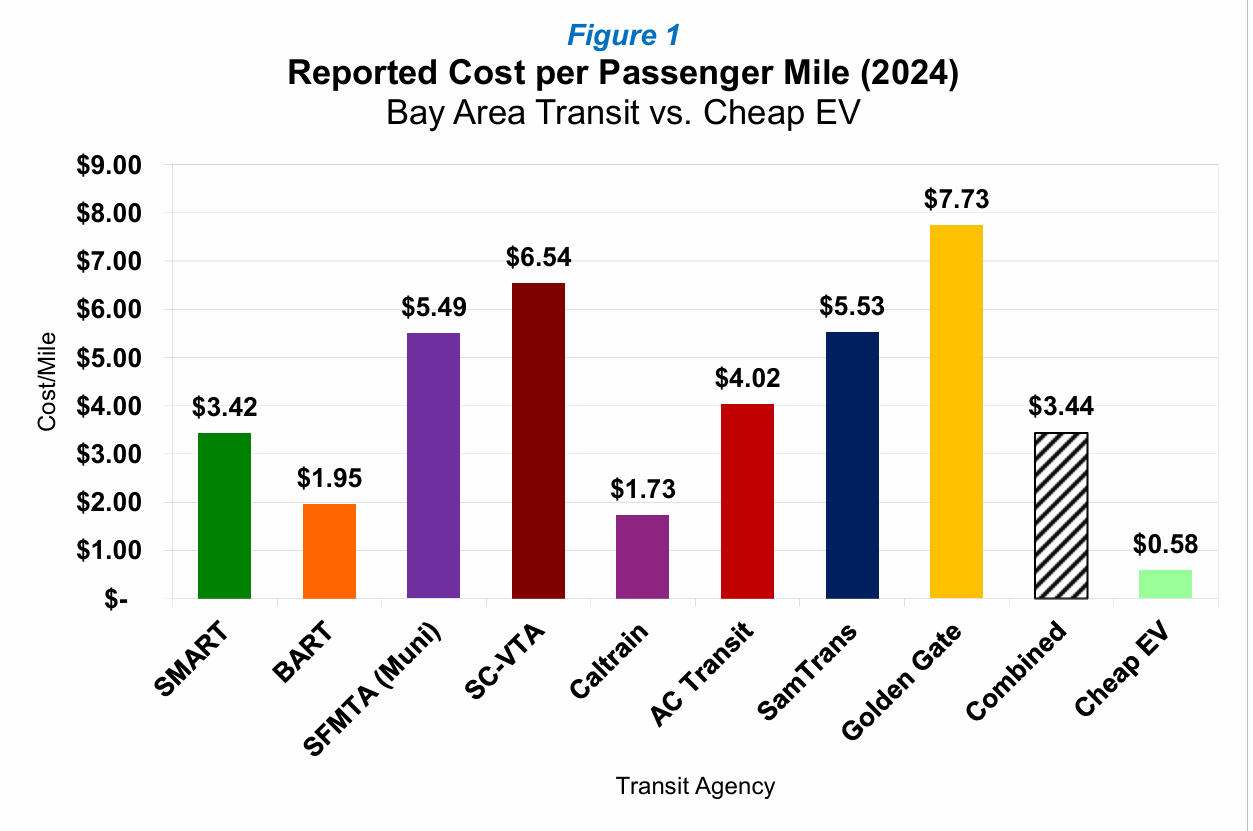
Even more striking is the massive inefficiency in capital asset utilization. The total fiscal burden per passenger mile, including capital assets requiring replenishment, unfunded retirement benefits, and outstanding long-term debt is staggering in comparison to a cheap EV (like my Chevy Bolt). These costs would be even worse if bond funding is required, because a 30-year bond at today’s rates approximately doubles the cost of each asset financed. Even without considering the cost of financing, Bay Area Traditional Transit ties up over 16 times as much money in funds as a cheap EV.
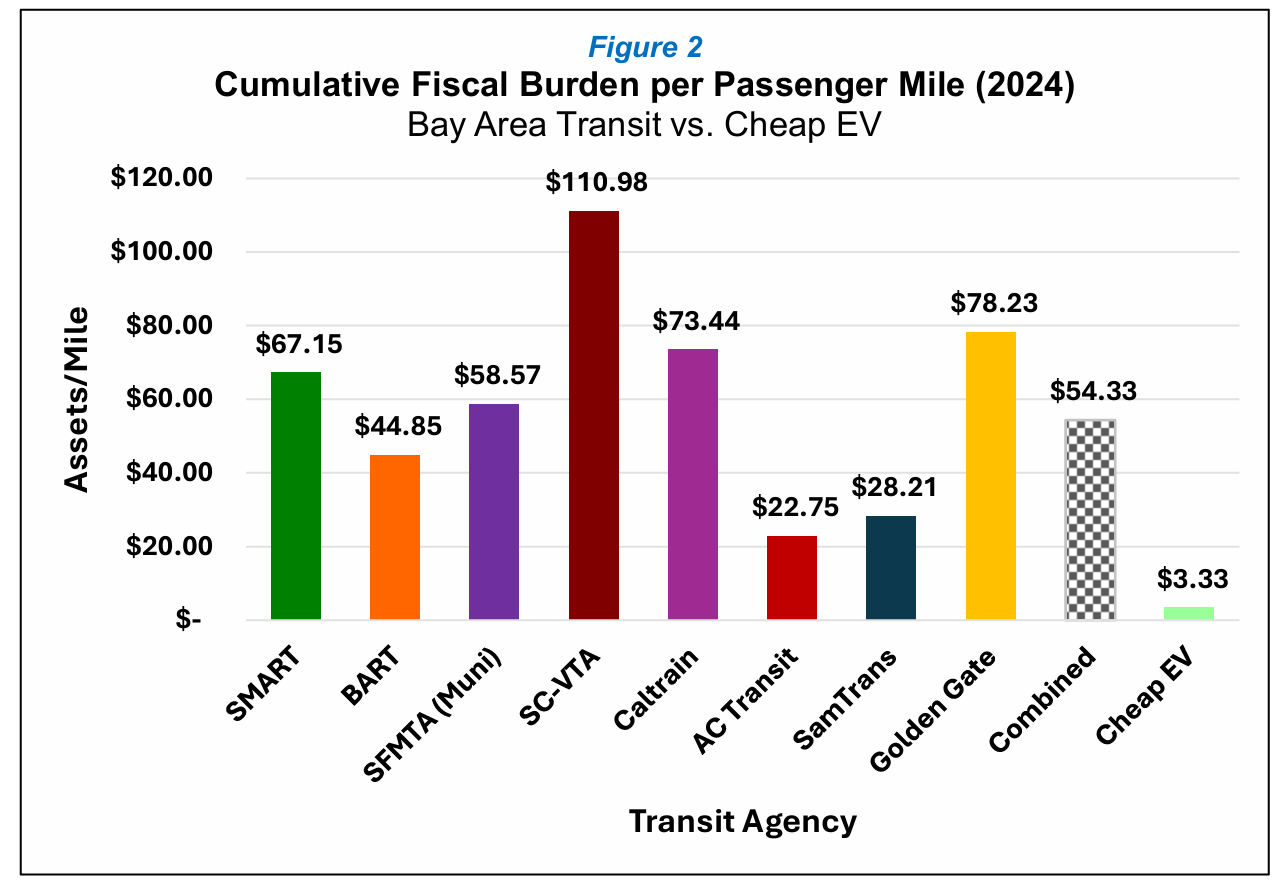
Transit agencies receive some funds from passenger fares, advertising, parking and other sources which reduce their annual operating cost deficits. The rest of their funding comes from subsidies, both statutory taxes & fees as well as discretionary contributions from federal, state, and local sources. What is most instructive is to look at the total SUBSIDIES per passenger mile, the costs not offset by earned income, which are the costs borne by even NON-riders of transit services. Figure 3 shows those subsidies per passenger mile:
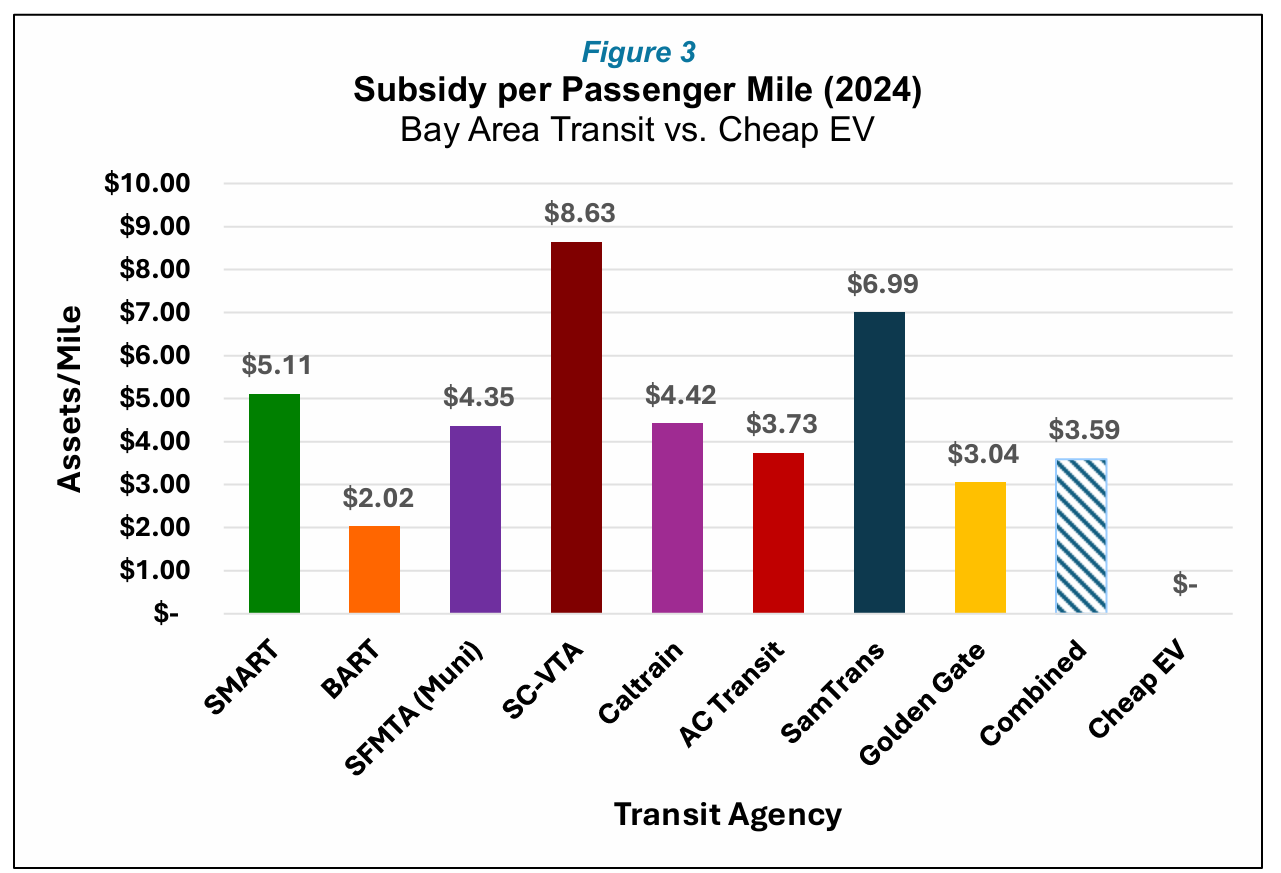
Note that for most of these agencies, the Subsidies EXCEED the reported operating costs, because of contributions for capital asset projects and other government assistance programs. Note that an owner-driven EV, or an autonomous EV service such as Waymo, involves no subsidies. San Jose Mayor Mahan has proposed providing $20 ride share credits in lieu of the VTA, because he understands how expensive Traditional Transit is.
The challenge for the Bay Area is to move from the costly bars on the left of these charts and toward the far right bar, where the costs and risks are borne by those benefiting from the service – e.g. the vehicle owners or businesses benefitting from workers and customers. We need to inaugurate cost-effective competition for these legacy bureaucracies, because at present they are not motivated to make themselves more efficient and are not delivering appropriate benefits for taxpayer funds.
San Mateo County (and the other counties in the Bay Area!) faces a plethora of funding needs, especially with the Trump Administration pulling funding from many programs. Those needs include: education, health care, climate change mitigation and adaptation (e.g. stormwater and SLR), and more. It is time for our elected leaders to realize that Traditional Transit costs are out of control, and to move toward more modern solutions so that our scarce resources can be used to address other priorities.
Gregg Dieguez
SHIFT-Bay Area Director of Sustainability and Montara resident.
Are you a subscriber? No?? Click this button and fix that situation asap. You be glad you did!!

Author: mdrag
x