
|
Getting your Trinity Audio player ready...
|
VIDEO. From the Sewer Authority Mid-Coastside (SAM) Director’s meeting on Monday, February 28th, 2022 at 7:00pm by Zoom.
SAM attorney, Jeremy Jungreis, presents.
What are PFAS or “Forever Chemicals” and Why Should We Care on the Coastside?
ARTICLE. “DARK WATERS” COME TO ORANGE COUNTY by Jeremy N. Jungreis and Jason Dadakis
Every generation seems to face a new challenge in cleaning up or remediating chemicals previously believed to be safe. In the past, it was Polychlorinated Biphenyls (PCBs) routinely sprayed on dirt roads to suppress dust, or volatile organic com pounds (solvents or VOCs) ubiquitous in dry cleaning and other degreasing operations that leaked into the groundwater. Both chemicals were allegedly linked to increased cancer risk and other adverse health effects through a variety of exposure pathways—including drink ing water.
Many of the VOC and PCB sites have now been cleaned up, but not without expensive litigation spanning decades. Now, as chronicled in the recent motion picture Dark Waters, there is growing concern about a new class of chemicals with the potential to adversely impact human health and the environment in Orange County. Per- and polyfluoroalkyl substances, abbreviated as PFAS, and nicknamed the “forever chemicals” because of their resiliency in the environment, are now receiving extraordinary regulatory scrutiny—spurring strict new state regulations and spawning litigation throughout the country.
What are PFAS, and Why Should I Care?
Perfluorooctanoic acid (PFOA) and per fluorooctane sulfonate (PFOS) are the two PFAS in the regulatory crosshairs of the State of California and the Federal Environmental Protection Agency (EPA). However, there are thousands of unique PFAS that have entered the stream of commerce in the United States, and by extension, the environment, over the last fifty years.
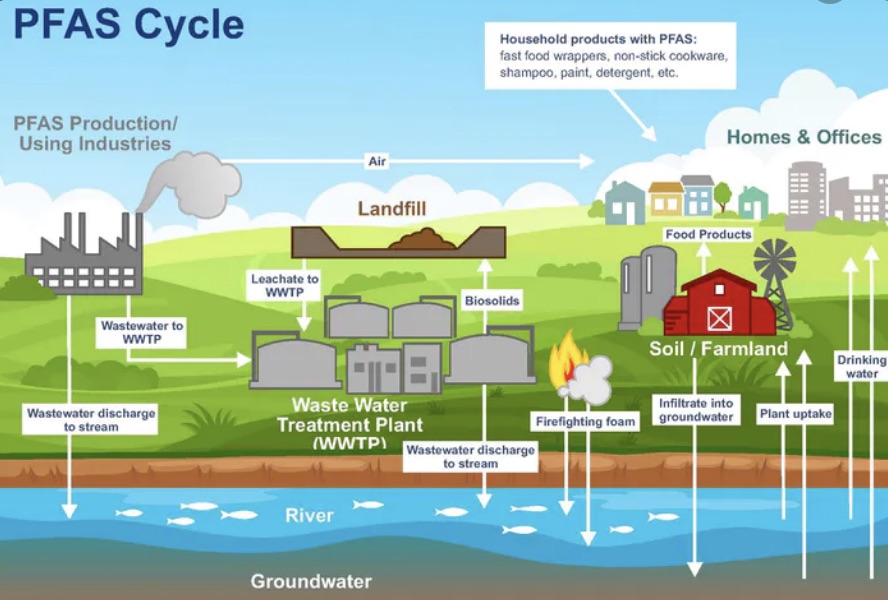
What makes PFAS cleanup such a difficult regulatory problem is that PFAS are literally everywhere. They are in Scotch Guard, GoreTex, Teflon, and count less other household products. Moreover, recent evidence suggests that our own bodies may have become a source of PFAS discharges to the environment—with PFAS residuals showing up in wastewater treatment plants throughout Southern California.
Recent studies suggest prolonged exposure to some types of PFAS, and in particular, PFOA and PFOS, may be associated with potential adverse effects on human health. According to the EPA, there are associations between PFOA exposure and high cholesterol, increased liver enzymes, decreased vaccination response, thyroid disorders, pregnancy induced hypertension and preeclampsia, and testicular and kidney cancer. The EPA indicates there is also possible association between PFOS and high cholesterol, decreases in fertility, and decreased birth weights.
PFAS chemicals have been detected in water sources throughout the Unit ed States, but for reasons unique and complex, PFAS are particularly prevalent in the inland portion of the Orange County Groundwater Basin (OC Basin) underlying much of northern and central Orange County. The result is a highly dynamic situation. Water agencies within the OC Basin have received strong recommendations from state regulators to shut down—until such time as expensive treatment can be designed and implemented—up to seventy-one separate wells, amounting to temporary curtailment of a large portion of northern and central Orange County’s water supply. These shut downs are set to occur during the first half of 2020. Meanwhile, litigation against PFAS manufacturers, and other parties responsible for releasing PFAS into the environment, is on the near horizon, along with new legislation, and possible admin istrative challenges to actions taken by the State Water Resources Control Board Division of Drinking Water (DDW).
How Did We Get Here?
As the movie Dark Waters chronicles, concerns over the safety of PFAS are not new—at least in parts of the country where PFAS is manufactured. According to the allegations of plaintiffs in West Virginia and Ohio, manufacturers of PFOS and PFOA have known about the potential dangers of PFAS for a long period of time, and they allegedly tried to cover it up.
In 2017, DuPont and Chemours agreed to pay $671 million to resolve multi-district litigation in Ohio that alleged that DuPont improperly dumped cancer-causing chemicals, thereby harming people exposed to the chemicals through drinking water and other exposure pathways.
In 2018, 3M reached an $850 million deal with the State of Minnesota settling litigation that alleged 3M knowingly dumped chemicals into ground water, impacting local wildlife and posing health risks to local water supplies.
Revelations from the litigation in the Midwest spurred the EPA to action.
In May 2016, the EPA released a Lifetime Health Advisory of a combined 70 parts per trillion (ppt) for PFOS and PFOA in drinking water.
In July 2018, DDW, which directly regulates California public water systems, established interim drinking water Notification Levels (NL) and Response Levels (RL) for PFOA and PFOS, based on recommendations from the California Office of Environmental Health Hazard Assessment (OEHHA). Results above the NL required water agencies to notify their local governing body (i.e., city council) and the governing bodies of other local agencies. DDW also set an RL for PFOS and PFOA at the same level as the EPA advisory.
In April 2019, DDW sent monitoring orders to more than 200 public water systems across California, including many in Orange County, requiring suppliers to test for PFOA and PFOS. The list of monitoring orders included 612 drinking water supply wells selected on the basis of proximity to landfills, municipal airports, and locations with past detections of PFAS.
In August 2019, DDW announced a new Notification Level for PFOA and PFOS, 5.1 parts per trillion (ppt) and 6.5 ppt, respectively, based on new recommendations from OEHHA. The RL for PFOA and PFOS would temporarily remain at the EPA level of 70 ppt for both contaminants. However, DDW indicated informally it was likely to revise the RLs to levels significantly below EPA advisory levels, 40 ppt for PFOS and 10 ppt for PFOA.
These suggested low levels would cause a significant number of wells within inland north-central Orange County to be in non-compliance with DDW’s proposed standard without any kind of public regulatory process.
Meanwhile, the California legislature, not content with allowing regulation of PFAS and PFOA to proceed via the normal regulatory process, passed AB 756. AB 756 requires water agencies who confirm PFAS in a drinking water source above the a designated RL, to either remove the source from service within thirty days or engage in an extensive public notification campaign, in multiple languages, and in print, electronic, and newspaper forums, that ensures every single customer of the water agency receives notice of the exceedance, the possible health effects of PFAS, and the agency’s decision not to take the drinking water source out of service.
AB 756 took effect on January 1, 2020. The new RLs for PFOS and PFOA were not far behind. DDW released them, without formal regulatory process or public hearing, on February 6, 2020.
As anticipated, the RL for PFOA was set at 10 ppt, and the RL for PFOS at 40.
In the same advisory, DDW indicated it was considering establishing NLs and RLs for seven other classes of PFAS. DDW concurrently issued guidance indicating AB 756’s public notification requirements would apply prospectively via a running annual average of quarterly samples, providing additional time for local agencies with PFOA or PFOS detections to come into compliance without triggering AB 756’s public notification requirements.
A De Facto Maximum Contaminant Level
The magnitude of the RL for PFOA in Orange County is significant—42 wells tested to date exceed the RL with approximately 30 more projected to exceed the new RL should testing be expanded. This fact, combined with the dearth of scientific evidence supporting the lower RLs, and the extremely stringent notification requirements triggered by AB 756, has led some attorneys to contend that DDW has engaged in the setting of a de facto maximum contaminant level (MCL) that violates California administrative law. The setting of an enforceable MCL is a process that ordinarily requires significant scientific (epidemiological and toxicological) study, and a thorough cost/benefit analysis. New Hampshire, seeking to be one of the first states to set an enforceable MCL for PFOS and PFOA (and two other PFAS com pounds), learned this the hard way when their MCL was enjoined by a New Hampshire state court judge on December 31, 2019.18 The court in New Hampshire enjoined enforcement of the MCL, which took effect on September 30, 2019, putting on hold New Hampshire’s 12 ppt for PFOA and 14 ppt for PFOS standards.
Back in California, recent actions by DDW to set the revised RL for PFOA and PFOS raise some of the same concerns as those expressed by water agencies in New Hampshire, namely an overly rapid process, inadequate public participation opportunities, and an unwillingness by regulators to follow the procedures set forth in the Federal Safe Drinking Water Act (SDWA) for setting enforceable drinking water standards. California regulators would likely respond to that criticism by contending that the RLs are not mandatory and that the law, as currently written, does not require public participation or comment prior to RL implementation; RLs are, DDW would likely argue, just very strong suggestions.
It remains to be seen whether formal challenges will be filed to the recently promulgated RLs. However, in the meantime, agencies such as the Orange County Water District (OCWD), which manages the OC Basin, are working to implement technical and engineering solutions that can rapidly bring ground water pumping lost to PFAS contamination back online. OCWD is also working with other interested agencies and the legislature to develop a regulatory process for the setting of RLs that provides greater predictability, scien tific rigor, and public participation as a formal part of any future RL development.
Tort Suits by Local Governments and States to Recover Damages for Injuries to Drinking Water
Litigation against PFAS manufacturers has exploded during the last year, with thousands of claims now pending against PFAS manufacturers in multi-district litigation currently pending in the Federal District Court for the District of South Carolina, as well as in various state court actions around the United States. State attorneys general, in states such as New Hampshire, Vermont, New York, Michigan, and New Jersey, have become involved too—filing lawsuits against PFAS manufacturers and alleging billions of dollars in damages for personal injury, natural resource, and property damage.
The manufacturers, for their part, contend PFOS and PFOA are not shown to harm human health, and that any release to the environment was consistent with federal law and, in some cases, military specification. How such litigation is resolved remains to be seen, but the recent large settlements in Ohio and Minnesota suggest there is potentially willingness on the part of at least some manufacturers to limit exposure through settlement—particularly where the plaintiffs can demonstrate direct discharges by a manufacturing facility that caused natural resource or aquifer damage.
PFAS, and the statutory, regulatory, and litigation actions it has catalyzed, promises to be an issue relevant to Orange County residents (and their lawyers) for the foreseeable future
“DARK WATERS” COME TO ORANGE COUNTY
by Jeremy N. Jungreis and Jason Dadakis
from the Orange County Lawyer
Jeremy is the Legal Counsel for Sewer Authority Mid-Coastside (SAM).
Link includes bibliography.
https://www.rutan.com/wp-content/uploads/2020/05/OC-Lawyer-Reprint-May-2020-Jungreis-Dadakis.pdf
Sewer Authority Mid-Coastside (SAM) Meetings ~ 2nd & 4th Mondays @ 7:00pm
Watch remotely. Comments and questions by email.
Agendas and Zoom Links
SAM Meeting Videos via Pacific Coast TV

Contact Us
Our Mailing Address is:
Sewer Authority Mid-Coastside
1000 Cabrillo Hwy N.
Half Moon Bay, CA 94019

Yellow = cancelled SAM meeting due to Holidays
(650) 726-7833 (fax)
Regular Board Meetings are on the 2nd and 4th Mondays of each month at 7:00pm.
From time to time a meeting date may be changed, cancelled or relocated. Check the posted agenda for any changes to the normal schedule (click on links below).
The Sewer Authority Mid-Coastside (SAM) provides wastewater treatment services and contract collection maintenance services for a population of approximately 27,000 in the following areas:
- City of Half Moon Bay
- El Granada
- Miramar
- Montara
- Moss Beach
- Princeton by the Sea
SAM Directors
Barbara Dye
Chair, Representing Granada Community Services District
Deborah Ruddock
Vice-Chair, Representing the City of Half Moon Bay
Kathryn Slater-Carter
Secretary/Treasurer, Representing Montara Water and Sanitary District
Dr. Deborah Penrose
Director, Representing the City of Half Moon Bay
Ric Lohman
Director, Representing Montara Water & Sanitary District
Matthew Clark
Director, Representing Granada Community Services District
VIDEO. Two pump failures in last two weeks.
Wipes and rags, as seen below, are the culprit.

Talk to your neighbors, please.
Repair for one pump can be $50,000.
Replacement is very, very expensive. A new pump can be a million dollars.
Burning out a generator can cost $100,000 to replace
~ Montara Sewer and Water District’s (MSWD) Board Member Kathryn Slater-Carter and MSWD General Manager, Clemens Heldmaier.
See how the sewer rates are static for years, then there has to be big increases?

Smaller Is Better: The Solution to California’s Ancient Water Pipes by Rinaldo Veseliza
Smaller Is Better: The Solution to California’s Ancient Water Pipes
Our aging infrastructure is a ticking time-bomb underground. We can begin to help repair it and stave off future trouble by reaping the benefits of smaller, decentralized microgrid systems.
A system at the San Francisco Public Utilities Commission helps recycle water for on-site reuse for irrigation and other needs.Tara Lohan
AS A PRACTICING architect and LEED AP (Leadership in Energy and Environmental Design, Accredited Professional) for more than 40 years, I have scoured the planet for technological solutions to improve sustainability with water, energy and waste treatment. During the course of my projects, I often see the underbelly of the beast where aging underground systems have the potential to erupt at any time, particularly in earthquake-prone areas such as California’s San Francisco Bay and Los Angeles.
Our greatest current and growing problem is restoring and improving infrastructure systems to last another 50 years. We cannot fix all the massive underground problems, but we can instead replace them with smaller, local surface-mounted solutions that will lead us to more flexible, manageable, decentralized and sustainable systems.
It is the equivalent of, in communication technology, switching from giant mainframes to using cellphones. The technology is all available, automated and user-friendly. Microgrid technologies started with NASA space missions where astronauts recycled all their waste into water and created their own power on board. It is now time to apply our inventions and sustainability principles through our communities to a larger spaceship – our planet.
The infrastructure started in primitive little towns across the world, then septic systems were replaced by larger central plants and distribution systems as cities grew. Waste treatment plants were moved away from town centers to where the smell could be dissipated and tolerated. As cities grew, all the infrastructure expanded into a massive network to manage everyone’s needs.
Today, as much of this infrastructure is dated, landlocked or falling apart, we should consider reverse-engineering the concept of distribution so that small communities, large buildings and individual homes can provide their own water, renewable energy/power (and storage) as well as waste-water treatment.
It is difficult to fix hundreds and thousands of miles of underground piping that we cannot see. Most municipalities do not even acknowledge its existence, especially in times of economic difficulties. Deferred maintenance has been a problem in cities worldwide.
Centralized systems were great, big, expensive and “permanent” solutions for growing communities during their earlier development.
Now, as these overgrown, dense cities are overwhelmed with growing populations, we need smaller-scale microgrids, which can remove the mystery of processing stormwater and sewage water into usable/potable water with self-contained prefabricated modular systems and automated quick-response services. Decentralized waste-water processing and recycling microgrids will actually create many more jobs than our current central systems. They will also reduce the potential impact of cyber attacks and massive system outages.
For example, for about $3,000, a traditional home can be outfitted to recycle 80 percent of its waste-water and use it locally, reducing the need for potable water by that same amount. Office complexes can treat and recycle their own waste to 80 percent recycling onsite for irrigation, toilets and cooling systems. City blocks can also recycle their waste-water locally and reprocess it mechanically to re-use onsite, significantly reducing costs for upgrading their failing underground piping.
These smaller-scale solutions can each reduce the need for potable water by 80 percent, which would be a major accomplishment for our society. They exist now and should be utilized in all future buildings as well as retrofitted.
In a city with many hills like San Francisco, where pumping uphill can be costly, the local solution can solve many current problems, including savings in replacement costs, increases in efficiency and greater flexibility with maintenance and operations. The technology has been around for a long time, but municipal politics has prevented any such conversions, often citing potential public health risks as the main reason for not abandoning existing centralized plants.
Yet the aging, leaking underground sewage pipes are causing growing numbers of system spills which have a significant impact on public health. We cannot see all the damage caused until it is too late, after our underground water sources are polluted. Many municipal systems are finally looking into recycling a small percentage of the water they currently process and dump.
Refurbishing our existing communities, buildings, homes and infrastructure is a massive undertaking. However, with newer technologies at lower costs, we can re-design our own facilities but also export the collective knowledge throughout the world. As usual, the Europeans are somewhat ahead of the game because of visionary/mandated governmental initiatives to improve efficiency, particularly with solar photovoltaic, wind, hydroelectric, waste-to-energy plants and biomass power generation. We have made great progress in recent years in re-inventing our building technologies and reviving our leadership in engineering.
Solar power is the best example of technology that is already modular, local and self-supporting, providing our energy needs at source, creating the opportunity for microgrids to replace long-distance power transmission systems and associated inefficiencies. Smaller is better.
Never miss an update. Sign up here for our Water Deeply newsletter to receive weekly updates, special reports and featured insights on one of the most critical issues of our time.
About the Author
ARCHITECT AND DIRECTOR OF SUSTAINABILITY, ALISTO ENGINEERING GROUP


Other Links
-
Wastewater and Microgrids for the Coastside? No More Inter-Tie or Outfall!?
- Video. SAM Employees Give BIG Thanks to General Manager Beverli Marshall for Her Four Years of Service.
- Video. What is ElectroScan & How Can it Help Sewer Authority Mid-Coast (SAM)?
- PODCAST. Managing sewage is the most important job on the planet ~Freakonomics: In Praise of Maintenance.
- Video. SAM Reports Zero Sewer Spills on the Coastside in 2018
- Video. SAM Meeting 4/22 ~ Partners with PG&E to Reduce its Carbon Footprint
TOUR of the Sewer Authority Mid-Coastside (SAM) Wastewater Plant ~ They Are Hiring; Will Train


Author: mdrag
x