
|
Getting your Trinity Audio player ready...
|
WHITE PAPER. By Rinaldo Veseliza, Environmental Architect.
I live in Half Moon Bay, a beautiful small town on the Pacific Coast of California. It needs help in staying sustainable when attracting tourists, growing organic crops and raising healthy children. As an Environmental Architect I am concerned about many aspects of our living environment which needs to be improved for our community to survive and thrive. The impact of Sewage is one of the least talked about issues which threatens our community, so let’s talk about it!
It may be scary and unpleasant but there are solutions we can adopt over time, so we need to address the issues including:
- Health issues from Polluted Beaches, Rivers and Streams
- Redistribution and Recycling of water
- Cost of septic system pollution to Tourism, Business, Reputation
- Cost of central wastewater plants, initial, maintenance and operations
- San Mateo County Septic Systems Maintenance Issues
- San Mateo First Flush Water Quality Reports
Wasted Water
Like most cities, Half Moon Bay has a small central sewage treatment plant to process wastewater to secondary level and then “waste” the processed water (that could be recycled) by dumping it into the ocean. Millions of gallons and millions of dollars invested in infrastructure maintenance and operations are lost each year and in perpetuity, by not treating the water to tertiary levels for re-use by the same communities that created the waste.
The majority of waste centralized treatment plants have no way of storing and recycling the water back to their customers. By creating independent local micro processing plants, communities and municipalities can easily process and recycle wastewater, reducing the need for fresh drinking water by 80-85%, saving the purest drinking water for drinking and avoiding pipeline, pumps, trucking and storage costs in distance areas by using all the water locally.. These same small local plants are perfectly capable of upgrades to convert sewage to drinking water and have a proven track record in many parts of the world.

If Not Now, When?
Right now, sustainable recycling at standard central plants cannot happen in meaningful quantities anytime in the foreseeable future. Central plants are typically designed to be at the low point of any particular community to allow for gravity to feed the liquid sewage and minimize the need for pump lift stations. The typical design would then require most plants to be retrofitted to process waste to tertiary level at minimum, then store and pump recycled water back up the hill to every customer. Even if central sewage treatment plants were retrofitted to purify wastewater for everyday use, it would be prohibitively expensive to retrofit every plant and install underground pipes and pumps to deliver the purified water back to customers, especially in densely populated areas where the underground is already saturated with utilities and structures.
Therefore, in virtually all cities, after secondary treatment, the polluted water is sent into the ocean, bay or streams, further contaminating our already troubled waterways. In order to stop this unsustainable current condition, there is only one significant option: install mini plants at each major manufacturing facility, office building, factory, school, community block and house and recycle the wastewater locally in your own back yard to be financed by the owner/user.
Proven Existing Technology
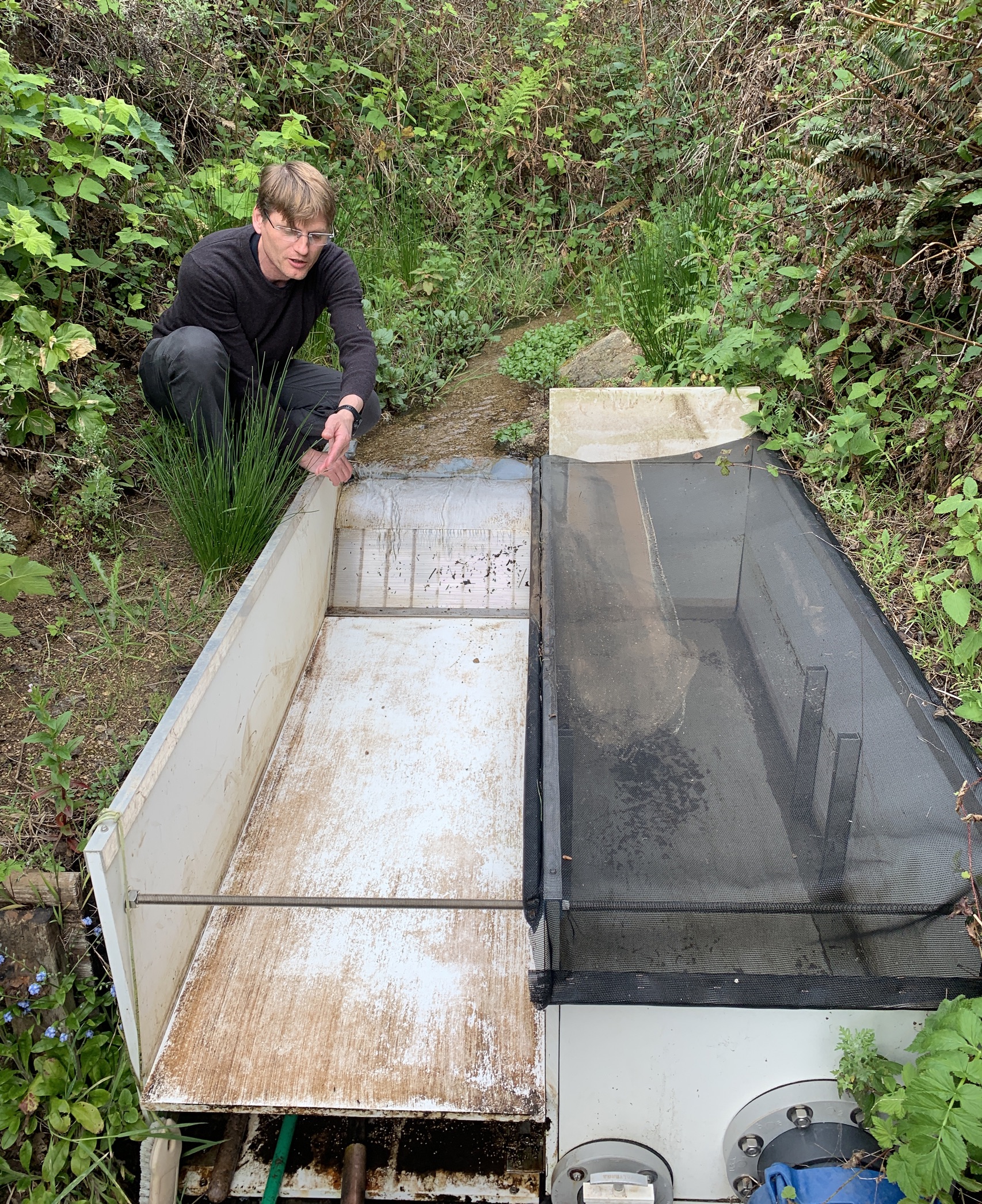
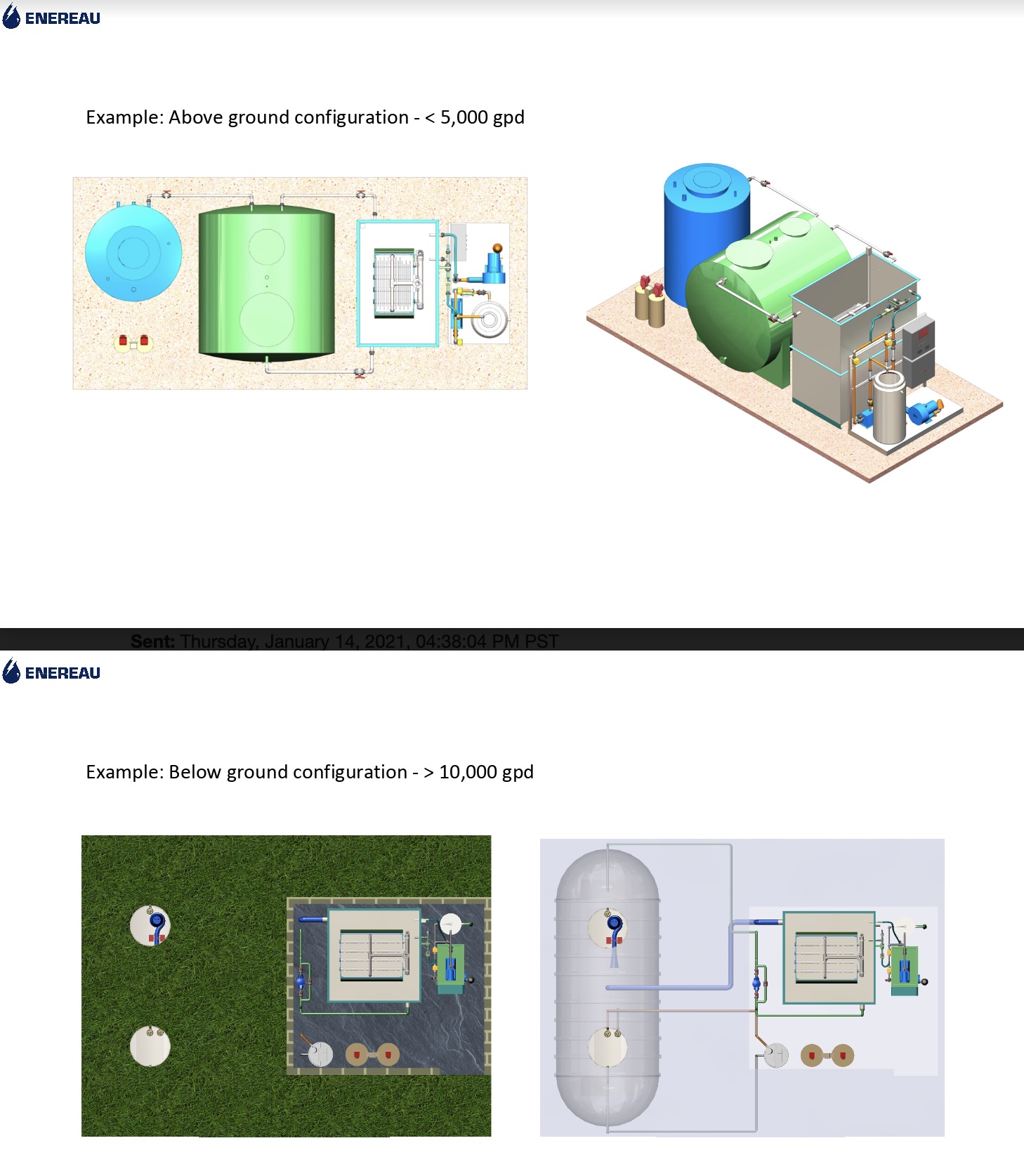
Miniature sewage treatment plants exist and have been used around the world for many years. As an Architect, I have been working with clients since 1998 designing systems for office complexes, municipalities, commercial development and residential communities. There are many affordable types of smaller, remote controlled modular plants available on the market which can address the needs of a community or business, especially where water usage is high and at a premium.
Current Examples
Small towns and remote communities should consider smaller plants especially if water is scarce, and users are far apart or separated by hills, especially when Central Plants are impractical and too expensive. Small plants are modular and can be expanded incrementally as conditions require. Schools are perfect candidates for using potable water and then recycling 80-90% after treatment on their sites for Building heating and cooling systems, landscape irrigation, Fire Sprinkler systems, and restroom facilities and refilling wells for future use. Many schools often are stuck with old pipelines from contaminated sources and are prime candidates to purify water to drinking quality, therefore could use similar systems just to purify their basic supplies.
Coastal Pollution to Popular Beach Areas
Coastal residential communities have been endangering their water sources and waterways for a long time by ignoring their own failed septic systems. Enforcement of the Clean Water Act was ignored. Officials turned their heads from publicizing their polluted beaches, especially in front of their most popular attractions, like Malibu Surfers Beach, where year after year the water test results would turn up in the Failed Category and many surfers would show up at medical facilities with illnesses and infections. Why publicize the bad when it would only deter more tourists and alienate residents?
Just sweep the bad news into the endless Pacific Ocean and let someone else worry about it. The pollution was coming from Malibu Creek and the surfaces of Downtown Civic Center, urban run-off combined with failed septic from the central shopping and business centers all contributed to high levels of bacteria and toxins in the water. After many years of debate and rejected permits, the City finally solved some of the problem by installing a small modular water treatment plant in the downtown area as a prototype for others to come. The biggest obstacles that my team tackled was the prejudice towards any change to the status quo. many projects that could have used the clean water were rejected outright because of the fear from civic leaders and landowners that the modular plants would lead to growth in a no-growth community where the ones who were “in” liked it just as it was for the last hundred years.
Case-in-point, Malibu Colony, one of the most expensive and exclusive waterfront communities, has had many cases of water pollution along its beaches over many years where owners, including several friends of mine, have been unknowingly swimming in their own sewage. Homeowners do not regularly check their septic systems for proper processing of sewage and other wastewater, ignoring the problem until State and Federal regulators step in after mass infections are reported by bathers. Sewage seems into their beachfront properties, infecting the sand and waters. Also, during high tides and storms, the saltwater kills off the good bacteria which should be processing the waste. This happens repeatedly across the state’s coastal waters and defeats the purpose and justification for septic systems.
- A large scale unit condominium community along the beaches of Ventura County which had spent millions to build a large septic treatment bed along the coast, only to have it fail to process the sewage due to salt water infiltration which killed the good bacteria. The State stepped in and fined the complex $25,000 a month for violating the Clean Water Act. The Complex was forced to pump and truck the raw sewage at a cost $30k/mo. until a replacement system could be designed and built. We designed a system that could be inserted into the Septic tanks to process the sewage, saving millions of gallons of water to be recycled locally and $millions in fines and trucking fees.
- A private new house of 2,500 sq.ft. in a remote area of Sonoma, isolated from any sewer systems, is designing for small modular plant that can process sewage at a rate of 500 gallons per day to a tertiary level of purity to be used on site for toilets, washing machines, fire storage, sprinklers and landscaping. The need for well water supply will be reduced by80-90%. The well water can also be purified to drinking quality with additional sterilization accessories.
- A 75 year old coastal resort hotel in the Virgin Islands had been devastated by hurricane winds which knocked out power and their sewage treatment plant. The existing damaged plant was partially salvaged to store water for the new small, modular treatment plant which was prefabricated off site and flown into place to reduce onsite installation costs and reduce time of construction to less than two weeks. The space required fit into the footprint of a shipping container, reducing the area reserved for the original plant. Due to proximity to the open ocean, the systems were designed with corrosion resistant materials. The fully aerobic process with in-tank jet aeration generated minimal sound and no odors so it could be placed in the landscaping near the hotel entrance.
- Schools, industrial facilities, greenhouses, residential, and commercial developments are applying these technologies in San Mateo County to replace septic systems as the preferred methods of eliminating waste. The Parks and Recreation department could also benefit from using fragile systems along the Coast and in remote rural areas where hordes of tourists overwhelm the local septic tanks and leach fields every season.
- In 1992, the City of Santa Monica issued permits to developers to build Water Garden, a 1.2 Million square foot office complex using a modular MBR plant system which recycled water for use on site for irrigation, lake, toilets, and sprinklers and building mechanical systems.
- SMURRF! The Water Garden project was so successful that the City opened its own plant in 2001 to treat the worst type of pollution storm water runoff polluted by street traffic tires and brake pads, oils, chemicals and garbage at a rate of 500,000 gallons per day. The Santa Monica Urban Run-off Reclamation Facility (SMURRF) is still operating today out of a 12ftx40ft container, with exterior tanks buried at the site.
- In 2002, when facing severe shortages of drinking water, the City of Singapore adopted the same systems to purify the country’s sewage to drinking quality by adding UV light and Ozone filters to the tertiary treatment. They bottled the water and sold it to the community.
- Cruise ships used the modular plants to purify wastewater and recycle it internally or let it into the Ocean at a cleaner quality than most central sewage treatment plants.
- There are many more examples from around the world than we can possibly name here.
Costs?
Today the advanced MBR systems are now much more affordable and available from various manufacturers and in many cases compatible in cost to septic systems. More important is the fact that they are much cheaper overall solutions than ultimately investing in large treatment plants, both in initial costs and maintenance and operations requirements. By relying on remote telemetry, these plants require minimal human contact, are simple to operate and very efficient.
They are the way for the present and future for sustainability.
~ Rinaldo Veseliza is an environmentally conscious Environmental Architect living along the coast in Half Moon Bay. rinaldoves@yahoo.com


Author: mdrag
x